Reviews
“Gopnik, a longtime New Yorker critic, isn’t the first author to emerge victorious from the American tournament of achievement only to discern its spiritual emptiness. But his contribution to an antidote feels original, and mercifully within reach. We need to refamiliarize ourselves, he thinks, with the profound and enlarging experience of truly mastering things, or at least attempting to do so … wise, companionable, and often extremely funny.”― Oliver Burkeman, The Atlantic
“Charming … some of its pleasures are Gopnik’s excursions into professional jargon―he takes his title from magicians’ shoptalk―and techniques … a collection of axioms defining what we might really mean by ‘mastery’ begins to crystallize for Gopnik … it’s lovely to see these rules emerge from a random assortment of disciplines―for instance, in the way the reader gradually discovers a structure of repeated sequences common to jazz, magic and boxing … The book’s final axiom is its most profound, all the more so for also being unexpected … The true mystery of mastery, he speculates, may be found not in a technique that must be learned, but, rather, in the infinitely renewable moment of performance.”― Adam Thirlwell, New York Times Book Review
“Gopnik is a writer with a keen, warm eye and a generous heart. In The Real Work he draws attention to what he calls the ‘asymmetry’ of mastery: ‘we overrate masters and underrate mastery,’ he says … Gopnik is such an affable guide, truthful about his own foibles, that the reader is happy to reflect with him … Near the end of The Real Work he conquers another terror, a very private one; that he reveals it, and shares his process, his setbacks and triumphs, is extremely moving. The joy of this book is its honesty. ‘The real work’ is a term magicians use to define who’s really got the chops. Gopnik may not be able to handle a deck of cards, but he is a magician, all the same.”― Erica Wagner, Financial Times
“[F]ascinating … because of the fluidity and incision of his prose, his ranging interest and knowledge, his capacity for deploying profound koans with casual verve … one of Gopnik’s salutary aims here is to demystify―and democratize―mastery.”― Tom Vanderbilt, Washington Post
“Via memoir, analysis and criticism, [Gopnik] assembles a celebration of the flaws that make us human … Gopnik is at his most moving when addressing the limited time we have on Earth; the roughly established number of heartbeats we are given to achieve whatever means most to us. In this context, he writes, mastery may have nothing to do with impressing some great portion of the public; instead, what counts is ourselves and a few people close to us. Mastery, he concludes, is ‘emphatically not transcendent.’ Instead, in Gopnik’s conception it is thoroughly democratic―something we all can achieve, and in many cases already have.”― Matthew Cantor, The Guardian
“Gopnik is consumed by the business of shaping sentences, and in The Real Work his dabbling in new skills, and observing those who’ve mastered them, unsurprisingly offers a way of reflecting on his own vocation … Among the uplifting pleasures of Gopnik’s writing is the range and ardour of his enthusiasms. If his only truly fanatical pursuit is making sentences, he seems to intuit that his best ones―his truest―are those that are unselfconsciously committed to their subject, and vitalised by the passionate curiosity that also reins them in.”― Lola Seaton, New Statesman
“Perhaps you’ll recognize Adam Gopnik from his cameo in Tár; perhaps you’ve read one of his many articles or books before now. His latest book, The Real Work, explores what it means to be at the top of one’s field, and finds Gopnik exploring professions from driving instructor to dancer to see what it means to be great at something. It’s a thoughtful and thought-provoking look at what it takes to become skilled at a certain kind of work.”― Tobias Carroll, InsideHook, “The 11 Books You Should Be Reading This March”
“Like Malcolm Gladwell, Gopnik makes even the seemingly workaday or mundane compelling … Gopnik’s book is aptly named, being his own exemplary example of the essayist’s craft.”― Bill Thompson, Post and Courier
“A tour de force … In a similar vein as Malcolm Gladwell’s Outliers, Gopnik’s book approaches the art of mastery of singular skills with the diligence of a researcher, the soul of a philosopher, and the heart of the everyday man.”― Shannon Carriger, Portland Book Review
“A masterful speculation on the nature and art of mastery. Gopnik, a longtime critic for the New Yorker and a librettist, tells us ‘the real work’ is a term used by magicians to refer to the ‘accumulated craft, savvy, and technical mastery that makes a great magic trick great….’ To fully appreciate the real work in others means gaining some sense of how it feels for them to do it, so Gopnik apprenticed himself to masters in various fields―magic, drawing, boxing, dance, etc.―to grasp their singular attainments, strategies, and styles…. Gopnik builds his book around Seven Mysteries of Mastery, deciphering these matters with shrewd but self-effacing skill… [his] intelligence gleams on nearly every page…. Like Malcolm Gladwell, he has a gift for forging connections and making even the seemingly mundane compelling. In top form, Gopnik makes his subject intellectually and viscerally thrilling.”― Kirkus Reviews, starred review
“[J]oyous and insightful … Through observation and deduction, Gopnik grasps much about the meaning of mastery … [Gopnik’s] unusual analysis of expertise and accomplishment includes his own charming moments and can-do attitude.”― Tony Miksanek, Booklist
“A masterful speculation on the nature and art of mastery… Gopnik’s intelligence gleams on nearly every page… like Malcolm Gladwell, he has a gift for forging connections and making even the seemingly mundane compelling. In top form, Gopnik makes his subject intellectually and viscerally thrilling.”― Kirkus Reviews, starred review
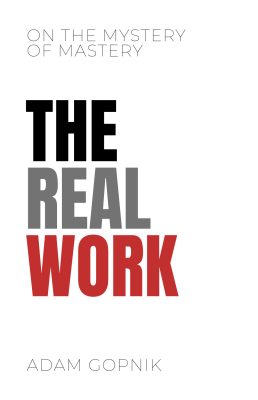
In The Real Work: On the Mystery of Mastery, Adam Gopnik takes readers on an engaging journey through the world of skill acquisition and expertise. This thought-provoking book explores the nature of mastery across various disciplines, from magic to dance, boxing to baking. Gopnik’s unique approach combines personal experiences, in-depth interviews, and insightful analysis to unravel the enigma of what it truly means to excel in a craft. By delving into the lives and practices of masters in their respective fields, the author challenges conventional wisdom about talent and hard work, offering fresh perspectives on the path to extraordinary achievement.
The Real Work is primarily aimed at curious intellectuals, lifelong learners, and anyone fascinated by the process of skill development and expertise. The book’s exploration of mastery across various fields makes it appealing to a broad audience, from aspiring artists and athletes to business professionals seeking insights into excellence. Gopnik’s accessible writing style ensures that complex ideas are presented in an engaging manner, making the book suitable for both casual readers and those with a deeper interest in psychology, sociology, or performance studies. While the concepts discussed may be sophisticated, Gopnik’s storytelling approach and relatable examples make the book accessible to anyone interested in understanding the journey to extraordinary achievement, regardless of their background or prior knowledge of the subject.
What if the path to true mastery isn’t paved with natural talent or even sheer determination, but instead winds through a mysterious landscape of subtle nuances and hidden depths? Adam Gopnik’s The Real Work: On the Mystery of Mastery challenges our preconceptions about what it takes to become extraordinary at a craft. Through a series of captivating encounters with masters in diverse fields, Gopnik peels back the layers of expertise to reveal a world far more complex and fascinating than most of us imagine.
Gopnik’s journey begins with a simple question: What separates the truly great from the merely good? To find answers, he immerses himself in the worlds of magicians, dancers, boxers, and even bakers. Each chapter reads like a mini-adventure, with Gopnik as our curious guide, attempting to learn these skills himself while probing the minds of those who have reached the pinnacle of their professions.
As we follow Gopnik’s explorations, we’re treated to a rich tapestry of insights about the nature of skill acquisition and the elusive quality of mastery. He discovers that true expertise often lies not in grand gestures or flashy techniques, but in the accumulation of countless small, seemingly insignificant details. A master baker’s ability to sense the perfect moment to remove bread from the oven, or a magician’s knack for misdirecting attention with the subtlest of movements – these are the “real work” that separates the exceptional from the ordinary.
The book challenges popular notions about the 10,000-hour rule and the idea that anyone can achieve mastery through sheer persistence. Instead, Gopnik suggests a more nuanced view, where innate talent, deliberate practice, and a certain ineffable quality all play crucial roles. He argues that true mastery involves not just technical proficiency, but also a deep, almost spiritual connection to one’s craft.
Readers of The Real Work will come away with a newfound appreciation for the dedication and artistry behind acts of mastery they encounter in everyday life. They’ll learn to recognize the hidden complexities in seemingly simple tasks and gain insights into their own pursuit of excellence, whatever their chosen field. Gopnik’s book serves as both a celebration of human potential and a humbling reminder of the vast depths of knowledge and skill that exist in the world around us.
The core message of The Real Work is that true mastery is a multifaceted, often mysterious process that goes far beyond the simplistic notions of talent or hard work. Gopnik argues that becoming extraordinary at a craft involves a complex interplay of factors, including innate ability, dedicated practice, intuition, and a deep, almost spiritual connection to one’s chosen field.
To illustrate this point, consider the art of baking bread. On the surface, it might seem like a straightforward process of following a recipe. But a master baker knows that perfect bread depends on countless variables – the humidity in the air, the subtle variations in flour composition, the precise moment when the dough has risen just enough. This mastery isn’t just about knowing facts or following steps; it’s about developing an almost unconscious feel for the process, a kind of dialogue between the baker and the bread.
Gopnik suggests that this level of mastery exists across all fields, from the physical prowess of a boxer to the sleight of hand of a magician. In each case, the “real work” of mastery lies not in grand, visible efforts, but in the accumulation of countless small details and an almost ineffable sense of rightness. This message challenges us to reconsider our understanding of expertise and encourages a deeper appreciation for the true nature of human excellence.
The Real Work: On the Mystery of Mastery makes a significant contribution to the field of expertise studies by offering a nuanced, multi-disciplinary perspective on skill acquisition and mastery. While many popular books on this topic focus on quantifiable metrics or universal rules for success, Gopnik’s work stands out for its emphasis on the subtle, often intangible aspects of true mastery.
The book’s significance lies in its ability to bridge the gap between academic research on expertise and the lived experiences of masters in various fields. By combining personal narratives, expert interviews, and thoughtful analysis, Gopnik presents a more holistic view of mastery than is typically found in either purely academic or purely anecdotal accounts.
Gopnik’s work has been widely praised for its engaging prose and insightful observations. Critics have noted its refreshing departure from the “quick-fix” mentality of many self-help books, instead offering a more realistic and nuanced view of what it takes to achieve excellence. The book has sparked discussions in fields ranging from education and psychology to sports and the arts, challenging conventional wisdom about talent development and the nature of expertise.
While generally well-received, some controversy has arisen around Gopnik’s challenge to popular theories like the 10,000-hour rule. His suggestion that mastery involves elements that can’t be easily quantified or replicated has led to debates about the role of natural talent versus deliberate practice in achieving excellence.
The Real Work has been recognized for its contributions to public understanding of expertise, earning praise from both academic circles and popular media. Its blend of rigorous inquiry and accessible storytelling has made it a valuable resource for anyone interested in the pursuit of excellence, from educators and coaches to aspiring masters in any field.
After carefully considering the strengths, weaknesses, and broader implications of Adam Gopnik’s The Real Work: On the Mystery of Mastery, we find it to be a valuable contribution to the literature on expertise and skill development. The book’s multidisciplinary approach and engaging narrative style offer readers a unique and thought-provoking exploration of what it truly means to master a craft.
We appreciate Gopnik’s nuanced take on the nature of expertise, which challenges simplistic notions of talent and practice. By focusing on the often overlooked or intangible aspects of mastery, the book provides insights that go beyond conventional wisdom. The author’s personal experiences and interviews with masters across various fields add depth and authenticity to the exploration.
However, we must also acknowledge the book’s limitations. The lack of quantitative evidence and potential selection bias in the examples used may leave some readers wanting more rigorous scientific backing. Additionally, the focus on high-level mastery might make some of the insights less immediately applicable for beginners or those pursuing more modest skill development goals.
Despite these shortcomings, we believe that The Real Work offers valuable perspectives that can enrich readers’ understanding of skill acquisition and the pursuit of excellence. The book’s emphasis on the complex, often mysterious nature of true mastery serves as a refreshing counterpoint to more formulaic approaches to success.
We think the book is particularly well-suited for readers who are already on their journey towards mastery in a particular field, as well as those with a philosophical interest in the nature of expertise. It may also be valuable for educators, coaches, and mentors looking to gain a deeper understanding of the subtle aspects of skill development.
Our Recommendation
We recommend The Real Work: On the Mystery of Mastery to readers seeking a thoughtful, nuanced exploration of what it means to truly excel in a craft or discipline. While it may not provide a step-by-step guide to achieving mastery, the book offers valuable insights that can inspire readers to approach their own pursuits with greater depth and appreciation for the complexities involved.
For those looking for practical strategies or a more scientific approach to skill development, we suggest complementing this book with works like Anders Ericsson’s Peak or Daniel Coyle’s The Talent Code. However, for readers interested in the philosophical and experiential aspects of mastery, Gopnik’s work stands out as a compelling and insightful read that can potentially transform how they view the journey to expertise.
The essence of Adam Gopnik’s The Real Work: On the Mystery of Mastery lies in its exploration of the nuanced and often elusive nature of true expertise. At its core, the book challenges popular notions about talent and practice, suggesting that mastery involves a complex interplay of factors that go beyond simple quantification or universal rules. Gopnik argues that the path to extraordinary skill is not linear or easily replicable, but rather a journey filled with subtle insights, intuitive leaps, and a deep connection to one’s craft.
One key topic Gopnik explores is the role of deliberate practice in achieving mastery. While he acknowledges the importance of dedicated effort, he pushes back against the idea that mastery is simply a matter of accumulating a certain number of hours. Instead, he suggests that effective practice involves a constant dialogue between the practitioner and their craft, with progress often coming in unexpected ways. This perspective adds nuance to the popular “10,000-hour rule,” highlighting the qualitative aspects of practice that are often overlooked.
Another crucial element of the book is its examination of the relationship between conscious and unconscious processes in skill development. Gopnik observes that many masters describe moments of flow or intuition that seem to transcend conscious thought. He explores how these seemingly effortless performances are actually the result of years of practice and experience, which allow experts to access deep wells of knowledge and skill without conscious deliberation. This insight challenges our understanding of how expertise operates and suggests that true mastery involves a kind of embodied knowledge that goes beyond what can be easily articulated or taught.
The book also delves into the role of failure and struggle in the journey to mastery. Gopnik finds that many experts have experienced significant setbacks or periods of doubt, which ultimately contributed to their growth and development. He suggests that these challenges are not merely obstacles to be overcome, but integral parts of the learning process that shape an individual’s approach to their craft. This perspective offers a more realistic and nuanced view of skill development, countering narratives that focus solely on talent or linear progress.
A key concept Gopnik introduces is the idea of “the real work” – the often invisible or underappreciated aspects of mastery that truly set experts apart. This could be a chef’s ability to instinctively adjust cooking times based on subtle changes in ingredients, or a musician’s capacity to convey emotion through minute variations in timing and tone. Gopnik argues that these elements, which often elude formal description or measurement, are at the heart of true mastery. By highlighting these aspects, he encourages readers to look beyond surface-level demonstrations of skill and appreciate the depth and complexity of genuine expertise.
The book also explores the tension between innovation and tradition in various fields of mastery. Gopnik observes that many masters have a deep respect for the history and conventions of their craft, while simultaneously pushing boundaries and developing new approaches. This balance between honoring tradition and fostering innovation emerges as a common thread across different disciplines, suggesting that true mastery involves not just replicating existing knowledge, but also contributing to the evolution of one’s field.
The Magician’s Misdirection: Gopnik describes his experience learning magic from a master magician. The magician demonstrates how true mastery in magic lies not in complex sleight of hand, but in the subtle art of misdirection. He shows how a simple gesture or word can completely divert an audience’s attention, allowing for seemingly impossible feats. This example illustrates how mastery often involves manipulating perception and expectations rather than just technical skill.
The Boxer’s Intuition: In exploring the world of boxing, Gopnik recounts a story of a champion boxer who could anticipate his opponent’s moves with uncanny accuracy. The boxer explains that this ability comes not from conscious thought, but from a deep, intuitive understanding of body language and rhythm developed over years of practice. This case study highlights how mastery can involve a kind of unconscious processing that surpasses conscious decision-making.
The Baker’s Touch: Gopnik shares his experience with a master baker who seems to have an almost supernatural ability to know when bread is perfectly baked. The baker explains that this skill comes from years of experience, during which he’s developed a sensitivity to subtle cues like the smell of the bread and the sound it makes when tapped. This example showcases how mastery often involves developing heightened sensory awareness and the ability to interpret complex, multisensory information.
The Dancer’s Flow: In his exploration of dance, Gopnik describes a prima ballerina’s experience of being “in the zone” during a performance. The dancer explains how, at the height of her mastery, she feels as if the dance is performing itself through her, with conscious thought falling away. This case study illustrates the state of flow that many masters experience, where their skills become so internalized that performance feels effortless and intuitive.
The Writer’s Struggle: Gopnik recounts the experiences of a renowned author who describes the constant struggle and self-doubt involved in their writing process. Despite their mastery and acclaim, the author still faces moments of uncertainty and difficulty with each new project. This example challenges the notion that mastery leads to effortless performance, instead suggesting that struggle and doubt can be ongoing companions even at the highest levels of expertise.
While Malcolm Gladwell’s popular “10,000-hour rule” suggests that expertise is primarily a function of time invested, Gopnik’s book reveals a more nuanced reality. True mastery involves not just the quantity of practice, but its quality and the practitioner’s mindset. To apply this insight, focus on deliberate, mindful practice rather than just logging hours. Set specific goals for each practice session, constantly challenge yourself with new techniques or approaches, and regularly seek feedback from mentors or peers. For example, if you’re learning a musical instrument, don’t just repeat the same pieces over and over. Instead, break down difficult passages, practice them in isolation, and experiment with different interpretations. Record yourself and listen critically, or perform for others to get constructive criticism.
Gopnik emphasizes that true mastery often involves a kind of knowledge that can’t be easily verbalized or taught through traditional methods. This “embodied knowledge” is acquired through years of experience and manifests as intuition or “feel” for one’s craft. To cultivate this type of knowledge, immerse yourself fully in your chosen field. If you’re a chef, for instance, don’t just follow recipes – experiment with ingredients, cook without measuring, and train your senses to detect subtle flavors and textures. Visit markets, talk to farmers, and eat at diverse restaurants to broaden your culinary understanding. Keep a journal to record your observations and insights, helping to bridge the gap between conscious learning and intuitive understanding.
Contrary to the idea that masters simply progress steadily towards perfection, Gopnik’s book highlights how setbacks and failures are often crucial to developing true expertise. To apply this insight, reframe your perspective on failure. Instead of seeing mistakes as setbacks, view them as valuable learning opportunities. After each failure, conduct a thorough post-mortem analysis. What went wrong? What can you learn from this experience? How can you adjust your approach going forward? For example, if you’re a public speaker who had a poor performance, don’t just try to forget about it. Instead, watch a recording of your speech, identify specific areas for improvement, and create a targeted plan to address these weaknesses in your next presentation.
Gopnik observes that many masters have a deep respect for the traditions of their craft while also pushing boundaries and innovating. To apply this insight in your own pursuit of mastery, start by thoroughly studying the history and established techniques of your field. If you’re a painter, for instance, learn classical techniques and study the works of old masters. At the same time, stay open to new ideas and technologies. Experiment with combining traditional methods with modern tools or concepts. You might, for example, use AI-generated images as inspiration for traditional oil paintings, or incorporate unconventional materials into classical painting techniques.
Gopnik introduces the concept of “the real work” – the often invisible or underappreciated aspects of mastery that truly set experts apart. To apply this insight, look beyond the obvious or flashy aspects of your craft and focus on developing the subtle skills that often go unnoticed. If you’re a writer, for example, don’t just focus on plot and character development. Pay attention to the rhythm of your sentences, the pacing of your paragraphs, and the overall structure of your work. Study how master writers use punctuation, sentence length, and word choice to create mood and tension. Practice rewriting the same scene in different styles to develop your versatility and control over these subtle elements.
Throughout the book, Gopnik draws connections between seemingly disparate fields, showing how principles of mastery often transcend specific disciplines. To apply this insight, look for opportunities to learn from experts in fields different from your own. If you’re a business strategist, for example, you might study the principles of military strategy or the techniques of improvisational theater. Attend lectures or workshops in diverse fields, read widely across disciplines, and seek out conversations with experts from various backgrounds. Look for patterns and principles that can be applied to your own area of expertise. This cross-pollination of ideas can lead to innovative approaches and deeper understanding of your craft.
While not explicitly stated as a central theme, Gopnik’s interactions with various masters throughout the book highlight the crucial role of mentorship in the journey to expertise. To apply this insight, actively seek out mentors in your field. Look for individuals who have achieved the level of mastery you aspire to, and don’t be afraid to reach out to them. Offer to assist them in their work, ask thoughtful questions, and be open to their guidance. If direct mentorship isn’t possible, study the biographies and methods of masters in your field. Analyze their career trajectories, their approaches to problem-solving, and their philosophies about their craft. Create a “virtual mentorship” by imagining how these masters might approach the challenges you face in your own work.
Many of the masters Gopnik encounters demonstrate an extraordinary sensitivity to subtle cues in their environment – the smell of perfectly baked bread, the almost imperceptible tells of an opponent in boxing, or the minute changes in audience energy during a performance. To apply this insight, practice mindfulness and sensory awareness exercises related to your craft. If you’re a wine taster, for example, don’t just focus on flavor. Pay attention to the wine’s aroma, its texture in your mouth, its visual characteristics, and even the sound it makes when swirled in the glass. Keep a detailed sensory journal, noting not just your observations but also how they change over time as your sensitivity develops. Regular meditation or mindfulness practices can also help sharpen your overall sensory acuity, which can then be applied to your specific field of expertise.
Gopnik’s book suggests that the path to mastery is rarely a straight line of continuous improvement. Instead, it often involves periods of rapid growth, plateaus, and even temporary regressions. To apply this insight, maintain a long-term perspective on your skill development. Keep a detailed log of your progress, noting not just your achievements but also your struggles and setbacks. This can help you identify patterns in your learning and recognize that periods of apparent stagnation are often necessary for consolidating skills. When you hit a plateau, instead of getting discouraged, view it as an opportunity to reinforce your foundational skills or explore new aspects of your craft. For example, if you’re a musician who feels stuck in your technical development, you might shift focus to improvisation or composition for a while, potentially leading to breakthroughs in your overall musicianship.
Gopnik’s exploration of mastery across various fields, from magic to baking, boxing to writing, provides a rich and diverse perspective on the nature of expertise. This multidisciplinary approach allows readers to see common threads and principles that transcend specific domains, offering a more comprehensive understanding of mastery. By drawing parallels between seemingly unrelated fields, Gopnik helps readers recognize that the journey to expertise often involves similar challenges and insights, regardless of the specific discipline. This broad view encourages readers to look beyond their own fields for inspiration and lessons, potentially leading to innovative approaches and cross-pollination of ideas.
One of the book’s major strengths is Gopnik’s ability to weave together personal experiences, expert interviews, and insightful analysis into a compelling narrative. Rather than presenting dry academic research or a series of disconnected anecdotes, Gopnik takes readers on a journey of discovery. His firsthand attempts to learn various skills add a relatable and often humorous element to the book, making complex concepts more accessible and engaging. This narrative approach not only makes the book more enjoyable to read but also helps readers connect emotionally with the stories and insights presented, potentially increasing the retention and application of the book’s key messages.
Gopnik’s book stands out for its nuanced and complex view of mastery. Instead of offering simplistic formulas or quick fixes, The Real Work acknowledges the multifaceted nature of expertise development. The book challenges popular notions like the 10,000-hour rule, offering a more sophisticated understanding of how mastery is achieved. By exploring the interplay between conscious effort, unconscious processing, innate talent, and environmental factors, Gopnik presents a holistic view of skill development that aligns more closely with current research in cognitive science and expertise studies. This nuanced approach provides readers with a more realistic and actionable understanding of what it takes to achieve true mastery.
A significant strength of the book is its emphasis on the often overlooked or underappreciated aspects of expertise. Gopnik’s exploration of what he calls “the real work” – the subtle, almost ineffable elements that separate true masters from skilled practitioners – offers valuable insights into the nature of exceptional performance. By highlighting these less visible aspects of mastery, such as a baker’s intuitive sense of when bread is perfectly baked or a magician’s ability to misdirect attention with the slightest gesture, Gopnik encourages readers to look beyond surface-level skills and appreciate the depth and complexity of true expertise. This focus can inspire readers to cultivate a deeper, more holistic approach to their own skill development.
Throughout the book, Gopnik maintains a sense of wonder and admiration for human capability. While acknowledging the challenges and complexities of achieving mastery, the book ultimately presents an optimistic view of human potential. By showcasing individuals who have reached extraordinary levels of skill in their chosen fields, Gopnik inspires readers to pursue excellence in their own endeavors. This celebratory tone, combined with the book’s nuanced exploration of the path to mastery, strikes a balance between motivation and realism, potentially encouraging readers to pursue their own journeys of skill development with both enthusiasm and a clear-eyed understanding of the challenges involved.
Gopnik skillfully combines philosophical inquiries about the nature of expertise with practical insights from real-world masters. This integration of abstract thinking and concrete examples provides a well-rounded exploration of mastery. The book doesn’t shy away from deeper questions about the meaning of expertise or the relationship between skill and identity, but it grounds these philosophical musings in tangible examples and experiences. This approach allows readers to engage with complex ideas while also gaining practical insights they can apply to their own pursuits. The balance between theory and practice makes the book valuable for both those interested in the intellectual aspects of expertise and those seeking practical guidance on skill development.
While Gopnik’s narrative approach and use of case studies provide rich qualitative insights, the book could benefit from more quantitative evidence to support its claims. The lack of hard data or controlled studies might leave some readers questioning the generalizability of the insights presented. For instance, when challenging popular notions like the 10,000-hour rule, more systematic evidence comparing different approaches to skill development could strengthen the argument. Including more references to empirical studies in expertise research would provide a stronger foundation for the book’s claims and satisfy readers looking for more rigorous scientific backing.
The book’s reliance on interviews with successful masters in various fields, while providing valuable insights, may introduce a selection bias. By focusing primarily on individuals who have achieved extraordinary levels of skill, the book might overlook the experiences of those who pursued mastery but didn’t reach the highest levels of achievement. This approach could potentially lead to a survivorship bias, where the strategies and experiences of successful individuals are overemphasized without considering whether these same approaches were also used by those who didn’t achieve mastery. Including more examples of individuals at different stages of the mastery journey, or even those who struggled or failed to achieve their goals, could provide a more balanced view of the path to expertise.
While The Real Work offers valuable insights for those already on the path to mastery or those interested in the philosophical aspects of expertise, it may fall short in providing concrete, actionable advice for beginners just starting their journey. The book’s focus on high-level mastery and subtle, advanced aspects of expertise could be intimidating or seem irrelevant to novices looking for basic guidance on how to start developing skills in a new area. Including more specific strategies or exercises for skill development at various stages of the journey, from beginner to advanced practitioner, would make the book more practically applicable to a wider range of readers.
In its nuanced exploration of mastery, the book at times may overemphasize the role of innate factors or talent in achieving high levels of skill. While Gopnik acknowledges the importance of practice and effort, some readers might interpret certain passages as suggesting that true mastery is only achievable for those with special gifts or predispositions. This could potentially discourage some readers from pursuing mastery in areas where they don’t feel naturally talented. A more explicit discussion of the interplay between innate factors and deliberate practice, along with examples of individuals who achieved high levels of skill despite initial lack of apparent talent, could provide a more balanced and motivating message.
While Gopnik’s book provides valuable insights into the nuanced nature of mastery, it may not fully address the critical role of deliberate practice in skill development. Readers might mistakenly conclude that mastery is primarily about intuition or innate talent, overlooking the importance of structured, goal-oriented practice. This blind spot could lead to a misconception that simply engaging in an activity for extended periods will naturally lead to expertise. In reality, the quality and structure of practice are often more important than quantity alone. Anders Ericsson’s Peak: Secrets from the New Science of Expertise offers a more in-depth exploration of deliberate practice, providing concrete strategies for designing effective practice routines. Similarly, Daniel Coyle’s The Talent Code delves into the neurological basis of skill acquisition, emphasizing the importance of targeted, challenging practice in developing expertise. These books could complement Gopnik’s work by providing readers with more specific guidance on how to structure their learning and practice for optimal skill development.
The Real Work may not fully explore the significant role that environmental factors play in the development of mastery. While Gopnik touches on the importance of mentorship and cultural context, readers might underestimate how access to resources, social support, and opportunities can dramatically influence one’s ability to achieve high levels of skill. This oversight could lead to a misconception that mastery is solely a product of individual effort and talent, ignoring the systemic factors that can either facilitate or hinder skill development. Malcolm Gladwell’s Outliers: The Story of Success provides a broader perspective on how cultural and environmental factors contribute to exceptional achievement. Additionally, David Epstein’s Range: Why Generalists Triumph in a Specialized World offers an alternative view to the traditional narrative of early specialization, highlighting how diverse experiences and environments can contribute to innovative thinking and ultimate mastery. These books could provide readers with a more comprehensive understanding of the external factors that shape the journey to expertise.
Gopnik’s book, while insightful about many aspects of mastery, may not fully address the psychological challenges that often accompany the pursuit of high-level expertise. Readers might underestimate the mental toll of striving for mastery, including issues like burnout, imposter syndrome, and the psychological impact of plateaus or setbacks. This blind spot could lead to unrealistic expectations about the emotional journey of skill development. Carol Dweck’s Mindset: The New Psychology of Success offers valuable insights into the psychological aspects of achievement, particularly the importance of cultivating a growth mindset. Angela Duckworth’s Grit: The Power of Passion and Perseverance provides a deeper exploration of the role of long-term commitment and resilience in achieving mastery. These books could complement Gopnik’s work by helping readers develop the psychological tools and mindsets necessary for navigating the challenges of the mastery journey.
The Real Work may not fully explore how the concept and pursuit of mastery are evolving in the digital age. Readers might overlook how technology is changing the landscape of skill acquisition, from online learning platforms to AI-assisted practice tools. This blind spot could lead to an overly traditional view of mastery that doesn’t account for new pathways to expertise emerging in the 21st century. Kevin Kelly’s The Inevitable: Understanding the 12 Technological Forces That Will Shape Our Future offers insights into how technology is reshaping learning and skill development. Additionally, Thomas L. Friedman’s Thank You for Being Late: An Optimist’s Guide to Thriving in the Age of Accelerations explores how the rapid pace of technological change is affecting our approach to knowledge and skill acquisition. These books could provide readers with a more forward-looking perspective on how the pursuit of mastery might evolve in the coming years, complementing Gopnik’s more traditional exploration of expertise.
Gopnik’s book, while rich in insights about the nature of expertise, may not fully address the ethical considerations that can arise in the pursuit and application of mastery. Readers might overlook important questions about the responsibilities that come with high-level expertise, the potential for misuse of advanced skills, or the ethical implications of dedicating one’s life to the pursuit of mastery in a particular field. This blind spot could lead to a one-dimensional view of mastery that focuses solely on skill development without considering its broader implications. Michael Sandel’s The Tyranny of Merit: What’s Become of the Common Good? offers a critical examination of how the pursuit of excellence can sometimes undermine social cohesion and exacerbate inequality. Peter Singer’s The Most Good You Can Do: How Effective Altruism Is Changing Ideas About Living Ethically could provide readers with a framework for thinking about how to use their developing skills and expertise for the greater good. These books could complement Gopnik’s work by encouraging readers to consider the ethical dimensions and social responsibilities that accompany the pursuit and achievement of mastery.
While both Gopnik and Gladwell explore the nature of exceptional achievement, their approaches and conclusions differ significantly. Gladwell’s Outliers emphasizes the role of external factors such as cultural background, birth date, and unique opportunities in shaping success. In contrast, Gopnik’s The Real Work focuses more on the internal processes and subtle aspects of skill development. Gladwell popularized the “10,000-hour rule,” suggesting that mastery primarily results from a specific quantity of practice. Gopnik challenges this notion, arguing for a more nuanced understanding of expertise that goes beyond simple accumulation of practice hours. However, both authors agree on the importance of environmental factors and opportunity in achieving mastery, though Gopnik places more emphasis on the qualitative aspects of skill development.
Ericsson and Pool’s Peak provides a more scientifically rigorous examination of expertise development compared to Gopnik’s more narrative-driven approach. While both books challenge simplistic notions of talent and innate ability, Peak offers a more structured framework for understanding skill acquisition through the concept of deliberate practice. Gopnik’s work complements this by exploring the less tangible, almost intuitive aspects of mastery that may not be captured by Ericsson’s more systematic approach. Peak provides more concrete strategies for improving performance, while The Real Work offers a richer exploration of the phenomenology of mastery and the subtle nuances that define true expertise.
Greene’s Mastery and Gopnik’s The Real Work both explore the journey to high-level expertise, but their approaches and focus differ. Greene’s book provides a more structured, almost formulaic approach to achieving mastery, drawing on historical examples and outlining specific stages of the mastery journey. In contrast, Gopnik’s work is more exploratory and less prescriptive, emphasizing the mysterious and often ineffable aspects of true expertise. While Greene focuses on providing a roadmap for readers to follow, Gopnik invites readers to appreciate the complexity and uniqueness of each individual’s path to mastery. Both books value the role of mentorship and immersion in one’s chosen field, but Gopnik’s work places greater emphasis on the subtle, often unconscious aspects of skill development.
Coyle’s The Talent Code and Gopnik’s The Real Work both challenge traditional notions of talent and innate ability, but they approach the subject from different angles. Coyle’s book focuses on the neurological basis of skill acquisition, emphasizing the role of myelin in developing expertise. It provides a more scientific explanation for how practice leads to mastery. In contrast, Gopnik’s work takes a more philosophical and experiential approach, exploring the lived experience of masters and the subtle nuances of high-level performance. While Coyle offers more concrete strategies for effective practice based on neurological principles, Gopnik provides a richer exploration of the qualitative aspects of mastery that may not be easily explained by neuroscience alone.
Embrace the Multifaceted Nature of Mastery
Cultivate Deliberate Practice
Embrace Failure as a Learning Tool
Balance Tradition and Innovation
Develop Embodied Knowledge
Cultivate a Growth Mindset
Develop a Support Network
Document Your Journey
Foster a Culture of Continuous Learning
Gopnik’s emphasis on the nuanced and complex nature of mastery can be applied to create a corporate culture that values continuous learning and skill development. This approach encourages employees to view their roles not just as jobs, but as crafts to be mastered over time. Companies can implement this by providing resources for ongoing education, creating mentorship programs, and recognizing and rewarding employees who demonstrate a commitment to developing expertise in their fields.
However, implementing such a culture can face resistance from employees who are comfortable with their current skill levels or from managers focused on short-term productivity. Additionally, allocating time and resources for continuous learning may be seen as a drain on immediate business needs, particularly in fast-paced or high-pressure industries.
To overcome these challenges, companies can start by clearly communicating the long-term benefits of continuous learning, both for individual career growth and for the organization’s overall competitiveness. Implementing a gradual rollout of learning initiatives, starting with pilot programs in receptive departments, can help demonstrate value before a company-wide implementation. Tying learning objectives to performance reviews and career advancement opportunities can also incentivize participation.
Embrace Failure as a Learning Tool
Gopnik’s insights on the role of failure in achieving mastery can be applied in a business context by creating an environment that views failures and setbacks as valuable learning experiences rather than causes for punishment. This approach can foster innovation, encourage calculated risk-taking, and ultimately lead to more robust problem-solving within the organization.
However, many businesses operate in environments where failures can have significant financial or reputational consequences. There may also be resistance from stakeholders who equate failure with incompetence or waste. Additionally, employees may be hesitant to admit or discuss their failures if they fear negative consequences for their careers.
To address these challenges, companies can implement a structured approach to learning from failure. This could include regular “failure analysis” sessions where teams discuss recent setbacks in a blame-free environment, focusing on extracting lessons and improving processes. Leaders should model this behavior by openly discussing their own failures and the insights gained from them. Establishing clear guidelines for acceptable risk-taking can help balance innovation with necessary caution. Additionally, incorporating lessons learned from failures into company knowledge bases or training materials can help demonstrate the value of this approach.
Develop Cross-Disciplinary Expertise
Gopnik’s exploration of mastery across various fields suggests that businesses could benefit from encouraging employees to develop expertise beyond their primary roles. This cross-pollination of skills and knowledge can lead to innovative problem-solving and more versatile employees.
Implementing this approach can be challenging due to time constraints and the potential for employees to lose focus on their primary responsibilities. There may also be resistance from managers who don’t see the immediate relevance of skills outside an employee’s current role. Additionally, measuring the impact of cross-disciplinary learning on business outcomes can be difficult.
To overcome these obstacles, companies can start by identifying areas where cross-disciplinary knowledge could be particularly beneficial and create structured programs to develop these skills. For example, a tech company might offer design thinking workshops to its engineers. Implementing job rotation programs or cross-departmental projects can provide practical opportunities for employees to apply and develop diverse skills. To address measurement challenges, companies can track metrics such as innovation output, problem-solving efficiency, and employee versatility over time.
Cultivate Tacit Knowledge
Gopnik’s emphasis on the intangible aspects of mastery highlights the importance of tacit knowledge – the kind of expertise that’s difficult to articulate or codify. In a business context, this suggests the need for strategies to capture and transfer this type of knowledge within the organization.
However, by its very nature, tacit knowledge is difficult to identify and document. There may also be resistance from employees who see their tacit knowledge as a source of job security. Additionally, traditional training methods may be inadequate for transferring this type of expertise.
To address these challenges, companies can implement mentorship programs that pair experienced employees with newer ones, allowing for the transfer of tacit knowledge through observation and practice. Creating opportunities for “job shadowing” or apprenticeship-style learning can also be effective. Companies can also experiment with technologies like virtual reality to create immersive learning experiences that better capture the nuances of expert performance. Recognizing and rewarding employees who effectively share their tacit knowledge can help overcome resistance to knowledge transfer.
Balance Tradition and Innovation
Gopnik’s observation that many masters balance deep respect for tradition with innovation can be applied in a business context by encouraging employees to thoroughly understand established best practices while also fostering a culture of innovation.
Implementing this balance can be challenging, as it requires simultaneously maintaining stability and encouraging change. There may be resistance from employees who are firmly entrenched in traditional methods, as well as from those who push for constant change without regard for established practices. Additionally, finding the right balance can be difficult and may vary across different parts of the organization.
To overcome these challenges, companies can create cross-generational teams that bring together experienced employees with newer ones, fostering a dialogue between traditional and innovative approaches. Implementing a structured innovation process that includes a thorough review of existing practices before proposing changes can help ensure that innovations build on, rather than simply replace, valuable traditions. Regular “innovation showcases” where teams present new ideas grounded in deep understanding of the field can help demonstrate the value of this balanced approach.
Develop Heightened Sensory Awareness
Gopnik’s insights on the importance of developing heightened sensory awareness in mastery can be applied in business contexts by training employees to be more attuned to subtle cues in their work environment, whether that’s in customer interactions, product development, or operational processes.
Implementing this approach can be challenging as it often involves developing skills that are not traditionally emphasized in business settings. There may be skepticism about the relevance or measurability of such “soft” skills. Additionally, the time required to develop this type of awareness may be seen as a luxury in fast-paced business environments.
To address these challenges, companies can start by identifying specific areas where heightened awareness could provide a competitive advantage, such as in customer service or quality control. Implementing training programs that include mindfulness practices, sensory exercises, and scenario-based learning can help employees develop these skills. Companies can also create physical spaces that encourage sensory engagement and awareness, such as quiet rooms for focused work or interactive spaces for creative collaboration. To demonstrate value, businesses can track metrics related to customer satisfaction, error rates, or innovation outcomes before and after implementing these practices.
As artificial intelligence continues to advance, the unique aspects of human mastery explored in Gopnik’s book become increasingly relevant. AI can replicate many skills, but the intuitive, creative aspects of true mastery remain distinctly human. This trend highlights the importance of developing deep, nuanced expertise that goes beyond easily automatable skills.
In the future, we may see a greater emphasis on cultivating the type of tacit knowledge and subtle expertise that Gopnik describes. This could lead to new approaches in education and professional development that focus on these uniquely human capabilities.
The growing gig economy presents both challenges and opportunities for those seeking mastery. On one hand, it allows individuals to pursue diverse experiences and learn from various fields. This aligns with Gopnik’s observations about the value of cross-disciplinary knowledge in achieving mastery.
However, the gig economy’s emphasis on short-term projects may make it harder for individuals to develop the deep, long-term engagement often necessary for true mastery. We might see the emergence of new models that balance the flexibility of gig work with opportunities for sustained skill development.
As VR and AR technologies advance, they offer new possibilities for the type of immersive, sensory-rich learning experiences that Gopnik identifies as crucial for mastery. These technologies could provide unprecedented opportunities for apprenticeship-style learning at a distance.
We may see the development of highly sophisticated VR/AR training programs that allow learners to experience and practice the subtle, often tacit aspects of mastery in various fields. This could democratize access to high-level expertise and change how we approach skill development across industries.
The growing “slow movement,” which emphasizes quality and depth over speed and quantity, aligns well with Gopnik’s exploration of the time and deep engagement required for true mastery. This trend could lead to a reevaluation of how we approach skill development and expertise in various fields.
We might see more programs and initiatives that encourage long-term, immersive learning experiences. This could contrast with and complement the trend towards rapid, modular learning often associated with digital education platforms.
Advances in neurotechnology, such as brain-computer interfaces and cognitive enhancement techniques, may offer new pathways to developing the type of expertise Gopnik describes. These technologies could potentially accelerate the development of the neural pathways associated with mastery.
While this trend raises ethical questions, it also opens up fascinating possibilities for understanding and cultivating mastery. We might see the emergence of new fields that combine traditional apprenticeship models with cutting-edge neurotechnology to foster accelerated yet deep learning.
The Real Work: On the Mystery of Mastery has the potential to significantly influence how we think about skill development and expertise in various fields. By challenging simplistic notions of talent and practice, Gopnik’s book may encourage a more nuanced and holistic approach to education and training programs. This could lead to a shift away from one-size-fits-all approaches to skill development and towards more personalized, context-sensitive methods that account for the subtle and often intangible aspects of mastery.
In the long term, Gopnik’s emphasis on the mysterious and ineffable aspects of expertise could inspire more research into the cognitive and emotional processes underlying high-level performance. This might lead to new insights in fields such as cognitive science, psychology, and neuroscience, potentially bridging the gap between objective measures of performance and subjective experiences of mastery.
The book’s multidisciplinary approach could also encourage more cross-pollination of ideas between different fields of expertise. By highlighting common threads in the mastery journey across diverse disciplines, Gopnik’s work might inspire professionals to look beyond their own fields for insights and innovative approaches to skill development.
In a broader societal context, The Real Work could contribute to a reevaluation of how we value and pursue expertise. By emphasizing the depth and complexity of true mastery, the book might encourage a shift away from quick-fix solutions and shallow demonstrations of skill towards a greater appreciation for deep, long-term engagement with a craft or discipline. This could have implications for how we structure education, career development, and even how we measure success in various fields.
However, the book’s impact may be limited by its narrative approach and lack of concrete, actionable strategies. While it provides valuable insights, readers looking for specific techniques to improve their skills might need to supplement Gopnik’s work with more practical guides. Additionally, the book’s focus on high-level mastery might make its insights seem less relevant to those in the early stages of skill development or those pursuing more modest goals.
As society continues to grapple with rapid technological change and automation, the insights from The Real Work could become increasingly relevant. The book’s exploration of the uniquely human aspects of mastery – the intuitive, creative, and deeply experiential elements that are difficult to replicate with artificial intelligence – might provide valuable perspectives on the types of skills and expertise that will remain distinctly human in an increasingly automated world.
Peak: Secrets from the New Science of Expertise by Anders Ericsson and Robert Pool: This book offers a more scientific approach to understanding expertise, complementing Gopnik’s narrative exploration. Ericsson’s research on deliberate practice provides a structured framework for skill development that readers can use alongside the insights from The Real Work. The book’s emphasis on the importance of targeted, purposeful practice adds a practical dimension to Gopnik’s more philosophical musings on mastery.
Outliers: The Story of Success by Malcolm Gladwell: Gladwell’s exploration of the factors contributing to high levels of success provides an interesting counterpoint to Gopnik’s focus on individual mastery. While Gopnik delves into the internal processes of skill development, Gladwell examines the external factors and circumstances that shape success. Reading these books in tandem offers a more comprehensive view of achievement, balancing personal effort with societal and environmental influences.
Mastery by Robert Greene: Greene’s historical approach to understanding mastery complements Gopnik’s contemporary examples. While Gopnik focuses on the lived experiences of modern masters, Greene draws lessons from historical figures across various disciplines. This book provides a broader context for understanding the universal principles of mastery that transcend time and specific fields of expertise.
The Talent Code by Daniel Coyle: Coyle’s investigation into the biological basis of skill acquisition offers a scientific perspective that complements Gopnik’s more experiential approach. By exploring the role of myelin in skill development, Coyle provides readers with a deeper understanding of the neurological processes underlying the mastery Gopnik describes. This book can help readers appreciate the physical changes that accompany the journey to expertise.
Mindset: The New Psychology of Success by Carol S. Dweck: Dweck’s work on growth mindset provides valuable insights into the psychological aspects of pursuing mastery. While Gopnik focuses on the process and experience of developing expertise, Dweck’s book offers strategies for cultivating the mental attitudes conducive to long-term skill development. Readers can use Dweck’s concepts to navigate the psychological challenges of the mastery journey Gopnik describes.
Flow: The Psychology of Optimal Experience by Mihaly Csikszentmihalyi: Csikszentmihalyi’s exploration of the state of flow aligns closely with Gopnik’s observations about the experiential aspects of mastery. This book offers a deeper dive into the psychological state often associated with high-level performance, providing readers with strategies for cultivating this state in their own pursuits of mastery.
Range: Why Generalists Triumph in a Specialized World by David Epstein: Epstein’s argument for the value of broad experience in developing expertise offers an interesting counterpoint to traditional notions of specialized practice. This book complements Gopnik’s work by exploring how diverse experiences can contribute to mastery, challenging readers to consider a more multidisciplinary approach to skill development.
Grit: The Power of Passion and Perseverance by Angela Duckworth: Duckworth’s examination of the role of perseverance in achieving long-term goals provides valuable insights into the psychological stamina required for the journey to mastery. While Gopnik focuses on the nature of expertise itself, Duckworth’s book offers strategies for maintaining motivation and commitment throughout the long and often challenging process of skill development.
Masterclass: This online platform offers classes taught by world-renowned experts in various fields, providing insights into their approaches to mastery. While not free, it aligns well with Gopnik’s exploration of expertise across different domains. (www.masterclass.com)
Coursera: This platform partners with top universities to offer online courses across a wide range of subjects. It’s an excellent resource for those looking to deepen their knowledge in specific areas, complementing Gopnik’s ideas on the importance of continuous learning in the pursuit of mastery. (www.coursera.org)
Ted Talks: The TED website features numerous talks on expertise, skill development, and mastery from various perspectives. These concise presentations can provide additional insights and inspiration related to the themes in Gopnik’s book. (www.ted.com)
World Conference on Science and Technology Education: This conference brings together educators and researchers to discuss advancements in teaching and learning, particularly in STEM fields. It offers valuable insights into the latest approaches to skill development and mastery in scientific disciplines. (Conference website varies by year)
Learning & the Brain Conference: This series of conferences explores the latest research in cognitive science and its implications for learning and skill development. It’s an excellent resource for those interested in the scientific underpinnings of mastery. (www.learningandthebrain.com)
Association for Talent Development (ATD): This organization focuses on workplace learning and performance. Its resources and events can provide valuable insights for those interested in applying Gopnik’s ideas on mastery in professional contexts. (www.td.org)
International Society for Expertise Research (ISER): This organization brings together researchers studying expertise across various domains. Its publications and conferences offer a more academic perspective on the themes explored in Gopnik’s book. (www.expertisestudies.org)
“Mastering Music” by Michael Emenau: This podcast explores the journey to mastery in music, featuring interviews with accomplished musicians about their learning processes and experiences. It offers a domain-specific exploration of themes similar to those in Gopnik’s book. (Available on major podcast platforms)
“The Knowledge Project” by Shane Parrish: This podcast features in-depth conversations with experts from various fields, often touching on themes of skill development and mastery. It’s an excellent resource for those looking to explore expertise across different domains. (Available on major podcast platforms)
“Learning How to Learn” on Coursera: This popular course, offered by Dr. Barbara Oakley and Dr. Terrence Sejnowski, provides insights into effective learning strategies based on cognitive science research. It offers practical tools for those pursuing mastery in any field. (www.coursera.org/learn/learning-how-to-learn)
“The Science of Well-Being” on Coursera: Taught by Yale professor Laurie Santos, this course explores psychological research on happiness and well-being. While not directly about mastery, it offers valuable insights into maintaining psychological health during the often challenging journey to expertise. (www.coursera.org/learn/the-science-of-well-being)
Jiro Dreams of Sushi: This documentary follows sushi master Jiro Ono, offering an intimate look at the dedication and attention to detail involved in achieving mastery in a specific craft. It provides a real-world example of many of the themes Gopnik explores in his book. (Available on various streaming platforms)
The Last Dance: While primarily about Michael Jordan and the Chicago Bulls, this documentary series offers insights into the pursuit of excellence in sports. It touches on themes of practice, mental toughness, and the drive for continuous improvement. (Available on Netflix)
Tim’s Vermeer: This documentary follows inventor Tim Jenison as he attempts to understand and recreate the painting techniques of Dutch master Johannes Vermeer. It offers an intriguing exploration of the intersection between art, science, and the pursuit of mastery. (Available on various streaming platforms)

Discover the key takeaways from top non-fiction books in minutes. Get the wisdom you need to succeed fast. Here, learning is quick, engaging, and always at your fingertips.
© 2025 All Rights Reserved.