Reviews
“A fireworks show of insights into how our minds work. If you want to avoid tripping on cognitive errors, read this book.” — Iris Bohnet, Professor and Academic Dean, Harvard Kennedy School, Director of the Harvard Decision Science Laboratory
“Dobelli examines our most common decision-making failings with engaging eloquence and describes how to counter them with instructive good sense.” — Robert Cialdini, author of Influence
“…a serious examination of the faulty reasoning that leads to repeated mistakes by individuals, businesses, and nations…In this fascinating book, Dobelli does not offer a recipe for happiness but a well-considered treatise on avoiding ‘self-induced unhappiness.’” — Booklist (starred review)
“…easy-going prose…what [Dobelli] does is pinpoint exactly the assumptions, bias and illusions that shape our thinking and decision-making processes in both business and personal relationships that can cost us dearly as individuals and as a society.” — Financial Times
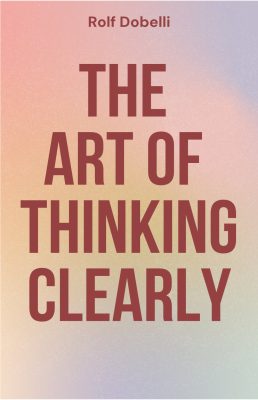
The Art of Thinking Clearly tackles the pervasive problem of cognitive biases that cloud our judgment and decision-making. This book is a compelling guide to understanding and overcoming these mental traps that lead to poor decisions in both our personal and professional lives. Dobelli presents 99 short chapters, each addressing a different cognitive bias or logical fallacy, offering practical advice on how to recognize and avoid them. What sets this book apart is its accessibility and the author’s engaging, anecdotal style, making complex psychological concepts easily digestible and applicable to everyday situations.
This book is ideal for anyone looking to improve their decision-making skills, from business professionals and entrepreneurs to students and educators. It is particularly valuable for those in leadership positions who need to make high-stakes decisions regularly. The language and concepts are accessible to a general audience, making it suitable for readers with no prior background in psychology or cognitive science. The short, standalone chapters make it easy to digest the material in small portions, perfect for busy readers.
Ever wondered why you often make decisions that you later regret?
Imagine navigating a dense fog where every step you take is uncertain, and the path ahead is obscured by clouds of confusion. The Art of Thinking Clearly by Rolf Dobelli serves as a powerful beacon in this fog, illuminating the cognitive biases and logical fallacies that cloud our thinking. Through 99 concise chapters, Dobelli unpacks these mental traps with engaging anecdotes and practical advice, aiming to help readers make clearer, better decisions in their personal and professional lives.
Dobelli begins with an eye-opening example of the “Survivorship Bias.” He recounts the story of World War II fighter planes returning from battle, which initially led engineers to reinforce the areas hit by enemy fire. However, by understanding that the planes that didn’t return were hit in other, more critical areas, they realized they needed to reinforce those instead. This chapter sets the stage for the book’s exploration of how our perceptions can be skewed by visible successes while ignoring invisible failures.
In The Art of Thinking Clearly, readers are guided through an array of biases like the “Confirmation Bias,” where people favor information that confirms their preexisting beliefs, and the “Sunk Cost Fallacy,” which traps individuals into continuing a losing endeavor due to the time or money already invested. Each chapter presents a specific bias, explains its significance, and offers practical tips to recognize and counteract it. This structure allows readers to easily understand and apply the insights to real-life situations.
The book offers a comprehensive toolkit for enhancing decision-making skills. Readers will learn how to avoid common thinking errors, improve their critical thinking abilities, and make more rational decisions. For instance, the “Halo Effect” explains how our overall impression of a person can influence our judgments about their specific traits. By understanding this, one can strive to evaluate people and situations more objectively, reducing the influence of superficial impressions.
Dobelli’s engaging writing style and relatable examples make complex psychological concepts accessible. He weaves in stories from various domains, including history, business, and everyday life, to illustrate how these biases manifest and affect our decisions. This approach not only makes the book enjoyable to read but also helps embed the lessons deeply, making them memorable and actionable.
The central message of The Art of Thinking Clearly is that human cognition is fraught with biases and logical fallacies that distort our perception and decision-making processes. Dobelli argues that by becoming aware of these mental traps, we can better navigate the complexities of life. The metaphor of cleaning a dirty window aptly captures this idea: just as a clear window offers an unobstructed view, a clear mind free from biases offers a more accurate understanding of reality.
The Art of Thinking Clearly has made a significant impact in the fields of psychology, business, and personal development. Its clear and engaging exploration of cognitive biases has resonated with a wide audience, earning it praise for its practical relevance and readability. The book has sparked discussions on how these biases influence everything from business strategies to personal relationships, challenging readers to rethink their decision-making processes.
Dobelli’s work has not been without controversy. Some critics argue that while the identification of biases is helpful, the solutions offered can sometimes seem simplistic or overly optimistic. Nonetheless, the book’s strength lies in its ability to make complex psychological insights accessible to a broad audience, encouraging a more mindful approach to thinking and decision-making.
The book has received numerous accolades and has been translated into several languages, underscoring its global relevance and appeal. Its success has also propelled Dobelli into the spotlight as a thought leader in clear thinking and rational decision-making, further cementing his authority in the field.
The Art of Thinking Clearly by Rolf Dobelli is a remarkable guide to understanding and mitigating the cognitive biases that influence our daily decisions. Throughout the book, Dobelli uses engaging anecdotes and practical advice to illuminate the numerous ways our thinking can go astray. His clear, accessible writing style makes complex psychological concepts understandable to a broad audience, making the book an excellent resource for anyone looking to improve their decision-making skills.
We appreciate the book’s thorough exploration of 99 cognitive biases, each presented in a concise, standalone chapter. This format allows readers to absorb and reflect on each concept individually, making it easy to revisit specific biases when needed. The practical tips provided at the end of each chapter empower readers to apply the insights immediately, enhancing the book’s real-world applicability.
While the book’s repetitiveness and occasionally superficial solutions might detract from its impact for some readers, its strengths far outweigh these weaknesses. The engaging writing style and practical focus make it an enjoyable and useful read. Dobelli’s ability to weave relatable stories into his explanations helps to reinforce the lessons and make them memorable.
However, The Art of Thinking Clearly does have its blind spots. It tends to overlook the influence of systemic and contextual factors on decision-making and underestimates the role of emotions. The book’s solutions can sometimes seem overly simplistic, and it doesn’t introduce much new research. Despite these limitations, the book remains a valuable starting point for anyone interested in understanding cognitive biases.
Our Recommendation
We highly recommend The Art of Thinking Clearly to a wide audience, from business professionals and students to educators and anyone interested in improving their thinking. The book’s practical advice and engaging style make it an accessible and enjoyable read, even for those with no prior background in psychology. By raising awareness of cognitive biases, Dobelli’s book offers valuable insights that can lead to better decision-making in both personal and professional contexts.
In conclusion, The Art of Thinking Clearly is an excellent resource for anyone looking to sharpen their critical thinking skills. Its broad relevance and practical applicability make it a worthy addition to any personal or professional library. Whether you are seeking to make more rational decisions, improve your problem-solving abilities, or simply understand the quirks of human thinking, this book provides the tools and insights needed to think more clearly and effectively.
At the heart of The Art of Thinking Clearly lies the exploration of cognitive biases—systematic patterns of deviation from norm or rationality in judgment. These biases affect our decisions and thinking processes, often leading to errors and misconceptions. By identifying and understanding these biases, Rolf Dobelli aims to equip readers with the tools needed to think more clearly and make better decisions.
One key topic Dobelli addresses is the “Confirmation Bias.” This bias describes our tendency to search for, interpret, and remember information in a way that confirms our preexisting beliefs while disregarding evidence that contradicts them. Dobelli explains how this bias can lead to a distorted view of reality, reinforcing our beliefs and opinions rather than challenging them, which can result in poor decision-making.
Another critical element is the “Sunk Cost Fallacy,” which refers to the irrational decision to continue an endeavor once an investment in money, effort, or time has been made. Dobelli illustrates how this fallacy causes people to persist with decisions that are no longer beneficial simply because they have already invested so much in them. Recognizing this fallacy helps individuals cut their losses and make more rational decisions.
The “Anchoring Effect” is another significant concept discussed in the book. This cognitive bias occurs when individuals rely too heavily on an initial piece of information (the “anchor”) when making decisions. Dobelli shows how this effect can skew judgments and lead to suboptimal outcomes, as people fail to adjust their estimates sufficiently from the anchor point.
Dobelli also explores the “Availability Heuristic,” a mental shortcut that relies on immediate examples that come to mind when evaluating a specific topic, concept, method, or decision. This heuristic can lead to a bias in judgment, as people tend to overestimate the importance of information that is readily available, often ignoring more relevant but less obvious data.
In discussing the “Survivorship Bias,” Dobelli highlights how focusing on successful individuals or entities can skew our understanding of reality. This bias leads us to ignore the countless unseen failures, giving us a false sense of how likely success is. By being aware of this bias, we can better appreciate the broader context and avoid unrealistic expectations.
Dobelli also delves into the “Halo Effect,” where our overall impression of a person influences our feelings and thoughts about their character. This bias can lead to skewed judgments about an individual’s abilities and performance based on unrelated qualities. Recognizing this effect helps in making more objective evaluations.
Survivorship Bias in World War II Planes
During World War II, engineers observed that returning fighter planes had bullet holes in certain areas. The initial conclusion was to reinforce those areas to increase survival rates. However, by recognizing the planes that didn’t return were hit in different, more critical areas, the engineers shifted their focus. This story vividly illustrates how survivorship bias can lead to flawed conclusions by only considering visible successes and ignoring the invisible failures.
Sunk Cost Fallacy in Business Decisions
Dobelli provides an example of a failing project that a company continues to fund simply because of the significant investments already made. Despite clear signs that the project will not succeed, decision-makers feel compelled to continue due to the resources already sunk into it. This example demonstrates how the sunk cost fallacy can trap individuals and organizations into persisting with bad investments, leading to further losses.
Anchoring Effect in Pricing
The book discusses how anchoring affects consumer behavior, particularly in pricing. When a product is initially introduced at a high price, subsequent discounts seem more attractive, even if the discounted price is still high. Consumers’ decisions are heavily influenced by the initial anchor, showing how first impressions can unduly influence our judgments and choices.
Availability Heuristic and Risk Perception
Dobelli uses the example of how media coverage of dramatic events, such as plane crashes, affects public perception of risk. Despite air travel being statistically safer than car travel, the vivid and frequent media reports of air accidents make people believe they are more common and dangerous. This example highlights how the availability heuristic can distort our understanding of reality and lead to irrational fears.
Halo Effect in Performance Reviews
The book illustrates the halo effect with performance reviews, where an employee’s overall positive impression can influence their evaluation in specific areas, regardless of their actual performance. For instance, a well-liked employee might receive higher marks across all criteria, even if their performance is average in some areas. Recognizing the halo effect helps in making more accurate and fair assessments.
Recognize Confirmation Bias
One of the book’s key insights is the importance of recognizing and mitigating confirmation bias. This bias leads us to favor information that confirms our preexisting beliefs while disregarding or discrediting contradictory evidence. To counter this, make a conscious effort to seek out diverse perspectives and challenge your assumptions. Engage in discussions with people who have different viewpoints and actively look for evidence that might disprove your beliefs. By doing so, you’ll develop a more balanced and accurate understanding of the world.
Avoid the Sunk Cost Fallacy
Dobelli highlights the sunk cost fallacy, where people continue an endeavor simply because of the time, money, or resources already invested, even when it’s clear that it’s no longer beneficial. To avoid falling into this trap, regularly reassess your commitments and projects based on their current and future value, not past investments. If the prospects are not promising, be willing to cut your losses and redirect your efforts to more fruitful ventures. This approach can save you from wasting valuable resources on doomed projects.
Be Wary of the Anchoring Effect
The anchoring effect occurs when we rely too heavily on the first piece of information we encounter when making decisions. This initial anchor can unduly influence our subsequent judgments. To mitigate this bias, consciously seek multiple sources of information before forming an opinion or making a decision. For example, if you’re negotiating a salary, research industry standards and gather various data points rather than focusing solely on the first offer. This strategy helps you make more informed and objective decisions.
Challenge the Availability Heuristic
The availability heuristic is a mental shortcut that leads us to overestimate the likelihood of events based on how easily examples come to mind. This can result in skewed risk assessments and poor decisions. To counter this bias, base your decisions on statistical data and empirical evidence rather than anecdotal experiences or media coverage. For instance, instead of relying on dramatic news stories about rare events, look at broader statistics to understand actual risks and probabilities. This method leads to more accurate and rational decision-making.
Understand the Halo Effect
The halo effect causes us to let our overall impression of a person influence our judgments about their specific traits. This bias can lead to unfair evaluations and decisions. To avoid this, separate your assessments of individual characteristics from your overall impression of someone. For instance, when conducting performance reviews, focus on specific behaviors and outcomes rather than general feelings about the employee. This practice ensures more objective and fair evaluations, fostering a more equitable environment.
Avoid Overconfidence
Dobelli warns against overconfidence, the tendency to overestimate our knowledge, abilities, and predictions. Overconfidence can lead to risky decisions and unforeseen failures. To temper overconfidence, regularly seek feedback, engage in self-reflection, and be open to learning from mistakes. Additionally, consider the possibility of alternative outcomes and plan for contingencies. By maintaining a realistic and humble view of your capabilities, you can make more prudent and well-informed decisions.
Guard Against the Illusion of Control
The illusion of control is the belief that we can influence outcomes that are largely determined by chance. This can lead to excessive risk-taking and poor decision-making. To guard against this illusion, differentiate between factors you can control and those you cannot. Focus your efforts on areas where your actions can make a difference, and avoid overestimating your influence in situations governed by luck or external forces. This mindset helps in allocating resources more effectively and reducing unnecessary stress.
Be Aware of the Planning Fallacy
The planning fallacy is the tendency to underestimate the time, costs, and risks of future actions while overestimating the benefits. This bias can lead to unrealistic expectations and project delays. To combat the planning fallacy, build in buffers for time and resources, and consult with others who have experience with similar projects. Additionally, review past projects to understand where estimations went wrong and adjust future plans accordingly. This approach leads to more accurate planning and successful project outcomes.
Understand Regression to the Mean
Regression to the mean is the phenomenon where extreme performances are likely to be followed by more average ones. This can lead to misattributions of success or failure to specific actions rather than recognizing statistical trends. To understand this, avoid making significant decisions based on extreme outcomes alone. Instead, consider the broader context and longer-term trends. This awareness helps in making more balanced and informed decisions, reducing the impact of short-term fluctuations.
Identify and Avoid Social Proof
Social proof is the tendency to follow the actions of others, assuming they have more knowledge about the situation. This can lead to herd behavior and poor decisions based on peer pressure rather than sound reasoning. To avoid falling prey to social proof, develop your criteria for decision-making and seek independent verification of facts. Question why you’re following a particular trend and whether it aligns with your values and goals. This critical approach helps in making decisions that are right for you, rather than just popular.
Insightful Exploration of Cognitive Biases
The Art of Thinking Clearly excels in its insightful and thorough exploration of cognitive biases. Rolf Dobelli identifies and explains 99 different biases, providing readers with a comprehensive understanding of the mental traps that can distort their thinking. Each bias is presented with clarity and backed by relevant examples, making the concepts easy to grasp. This depth of coverage helps readers recognize these biases in their daily lives and offers practical strategies to mitigate their effects.
Clarity of Arguments
Dobelli’s writing style is clear and concise, making complex psychological concepts accessible to a broad audience. He avoids jargon and uses straightforward language, which enhances readability and comprehension. The short chapters, each focusing on a single bias, allow readers to absorb the material in manageable portions. This structure helps maintain the reader’s interest and makes the book a valuable reference tool for revisiting specific biases when needed.
Engaging Writing Style
The book’s engaging writing style sets it apart from other works on similar topics. Dobelli uses anecdotes, real-life examples, and humor to illustrate his points, which makes the content more relatable and enjoyable to read. His ability to weave in stories from various fields, including history, business, and everyday life, keeps the reader engaged and helps to reinforce the lessons being taught.
Practical Applicability
One of the book’s major strengths is its practical applicability. Dobelli doesn’t just explain the biases; he offers concrete advice on how to recognize and avoid them. This practical approach makes the book highly useful for readers looking to improve their decision-making skills in both personal and professional contexts. The actionable tips provided at the end of each chapter empower readers to apply what they’ve learned immediately, enhancing the book’s real-world relevance.
Broad Relevance
The themes and lessons in The Art of Thinking Clearly are broadly relevant, making the book appealing to a wide audience. Whether you’re a business professional, student, educator, or simply someone interested in improving your thinking, the insights offered are universally applicable. This broad relevance ensures that the book’s impact extends beyond specific fields or disciplines, making it a valuable addition to anyone’s library.
Repetitiveness
One of the book’s notable weaknesses is its repetitiveness. While the focus on 99 biases provides thorough coverage, some readers might find the format somewhat redundant. The structure of presenting each bias in a similar manner can lead to a sense of déjà vu, where the chapters start to blend together. This repetitiveness can potentially diminish the overall impact of the insights provided.
Superficial Solutions
Although Dobelli does an excellent job of identifying and explaining cognitive biases, the solutions offered can sometimes seem superficial. The advice given is often straightforward and lacks depth, which may not be sufficient for readers looking for more robust strategies to combat these biases. The book could benefit from a more detailed exploration of the methods to counteract each bias, providing readers with deeper, more nuanced approaches.
Lack of New Research
While The Art of Thinking Clearly is grounded in established psychological principles, it does not introduce much new research or groundbreaking findings. Dobelli largely relies on existing studies and well-known concepts, which might be disappointing for readers seeking fresh insights or novel approaches. The book serves more as a summary and practical guide rather than a source of new academic contributions.
Overemphasis on Personal Anecdotes
Dobelli’s frequent use of personal anecdotes, while engaging, can sometimes overshadow the scientific rigor of his arguments. While stories and examples are useful for illustration, they occasionally lead to generalizations that might not hold up under closer scrutiny. This reliance on anecdotes can sometimes undermine the credibility of the book’s claims, as they may not always be representative of broader trends or evidence-based conclusions.
Overlooking Systemic and Contextual Factors
One significant blind spot in The Art of Thinking Clearly is its focus on individual cognitive biases while largely ignoring systemic and contextual factors that influence decision-making. Dobelli emphasizes personal responsibility in recognizing and mitigating biases but doesn’t adequately address how external environments and social systems contribute to these biases. For instance, organizational culture, societal norms, and peer pressure can significantly shape our thinking patterns. Books like Thinking, Fast and Slow by Daniel Kahneman delve deeper into the interplay between individual cognition and external influences, offering a more comprehensive understanding of how biases operate within broader contexts.
Underestimating Emotional Influences
Another overlooked aspect is the role of emotions in decision-making. While Dobelli’s work is grounded in rational thought, it often sidesteps how emotions can profoundly impact our judgments and choices. Emotions are a critical component of human decision-making, sometimes even overriding rational analysis. Emotional Intelligence by Daniel Goleman addresses this gap by exploring how understanding and managing emotions can lead to better decision-making and interpersonal relationships. Integrating emotional awareness with cognitive biases could provide a more holistic approach to clear thinking.
Simplistic View of Cognitive Corrections
Dobelli’s strategies for overcoming cognitive biases can come across as overly simplistic. The book suggests that awareness and conscious effort are enough to counteract biases, but real-world applications are often more complex. Cognitive biases are deeply ingrained and can be difficult to overcome even with knowledge and intention. Books like Nudge: Improving Decisions About Health, Wealth, and Happiness by Richard H. Thaler and Cass R. Sunstein offer more nuanced strategies, such as designing environments that naturally guide better decisions, acknowledging that simply knowing about biases isn’t always sufficient for changing behavior.
Neglecting the Positive Aspects of Biases
A common misconception that might arise from The Art of Thinking Clearly is that all biases are inherently negative and should be eliminated. However, some cognitive biases have adaptive benefits and can enhance decision-making in certain contexts. For instance, heuristics, which are mental shortcuts, can be efficient and effective when making decisions under uncertainty. Books like The Power of Intuition by Gary Klein highlight how these intuitive judgments, shaped by experience, can be valuable, especially in fast-paced or high-stakes environments. Recognizing the situations where biases can be beneficial would provide a more balanced perspective.
Assuming Universal Applicability
Dobelli’s book may give the impression that the cognitive biases and solutions he describes are universally applicable across different cultures and contexts. However, cultural variations can significantly influence how biases manifest and how they should be addressed. What works in one cultural context might not be effective in another. Culture and Psychology by David Matsumoto and Linda Juang explores how cultural differences impact psychological processes, including decision-making. Acknowledging these cultural nuances would make Dobelli’s insights more globally relevant and applicable.
Focusing Solely on Individual Improvement
The Art of Thinking Clearly primarily focuses on individual cognitive improvement without sufficiently addressing how collective or collaborative efforts can enhance decision-making. In many situations, decisions are made in groups or teams, and understanding how to navigate biases in these contexts is crucial. The Wisdom of Crowds by James Surowiecki examines how group decision-making can often lead to better outcomes than individual choices, provided the group dynamics are well-managed. Integrating insights on collective intelligence would enhance the practical applicability of Dobelli’s recommendations for those who work in team environments.
Thinking, Fast and Slow by Daniel Kahneman
Rolf Dobelli’s The Art of Thinking Clearly and Daniel Kahneman’s Thinking, Fast and Slow both explore cognitive biases and their impact on decision-making. However, Kahneman’s work delves deeper into the dual-process theory of cognition, distinguishing between the fast, intuitive System 1 and the slow, deliberate System 2. Kahneman provides a more comprehensive theoretical framework for understanding how biases arise from these two modes of thinking. While Dobelli’s book is more accessible and practical for a general audience, Kahneman’s detailed exploration offers a richer understanding of the underlying psychological mechanisms, making it more suitable for readers seeking an in-depth academic perspective.
Nudge: Improving Decisions About Health, Wealth, and Happiness by Richard H. Thaler and Cass R. Sunstein
Nudge by Thaler and Sunstein offers a different approach to improving decision-making by focusing on the concept of “nudging” people towards better choices through subtle changes in the environment. While Dobelli emphasizes personal awareness and individual strategies to combat biases, Thaler and Sunstein advocate for designing choice architectures that guide people to make better decisions without restricting their freedom. This contrast highlights differing viewpoints on how to address cognitive biases: Dobelli’s approach is more about self-awareness and personal effort, whereas Nudge suggests systemic interventions as a more effective solution.
Predictably Irrational: The Hidden Forces That Shape Our Decisions by Dan Ariely
Dan Ariely’s Predictably Irrational shares similarities with Dobelli’s book in exploring the irrational behaviors and cognitive biases that influence decision-making. Ariely’s work is particularly notable for its reliance on empirical experiments to illustrate how and why these biases occur. While Dobelli provides a broad overview of numerous biases with practical tips, Ariely dives deeper into specific biases through detailed experimental evidence and analysis. Ariely’s approach is more research-driven and provides a scientific basis for understanding irrational behavior, whereas Dobelli’s book is more of a practical guide aimed at a wider audience.
The Power of Intuition by Gary Klein
Gary Klein’s The Power of Intuition contrasts with Dobelli’s skepticism about biases by highlighting the positive aspects of intuitive decision-making, especially in expert contexts. Klein argues that intuition, developed through experience and expertise, can lead to effective decisions in high-pressure situations. This viewpoint presents a counterbalance to Dobelli’s emphasis on avoiding cognitive biases. Klein’s focus on the value of intuition suggests that not all biases are detrimental and that they can be harnessed beneficially under certain circumstances. This comparison underscores the importance of context in evaluating the utility of cognitive biases and decision-making strategies.
Action Plan
Identify and Recognize Biases
Seek Diverse Perspectives
Challenge Your Assumptions
Base Decisions on Evidence
Mitigate the Sunk Cost Fallacy
Use Multiple Anchors
Develop Emotional Awareness
Plan with Realistic Expectations
Foster Objective Evaluations
Nurture Critical Thinking
Implement Training Programs on Cognitive Biases
Training programs focused on cognitive biases can help employees at all levels understand how these biases influence their decision-making and work processes. By educating staff about common biases such as the confirmation bias, sunk cost fallacy, and anchoring effect, businesses can foster a culture of critical thinking and better decision-making. These programs can be integrated into onboarding processes or regular professional development sessions, ensuring that employees continually develop their awareness and skills.
One potential obstacle is employee resistance to additional training, especially if they perceive it as time-consuming or irrelevant to their daily tasks. Busy schedules and heavy workloads can also make it challenging to find time for such programs, leading to low participation rates.
To overcome these challenges, businesses can make the training programs more engaging and relevant by using real-life examples and interactive workshops. Scheduling training sessions during less busy times and offering them in bite-sized, on-demand formats can also help increase participation. Additionally, highlighting the tangible benefits of improved decision-making, such as increased efficiency and reduced errors, can motivate employees to engage with the training.
Promote a Culture of Diverse Perspectives
Encouraging diverse perspectives within teams and decision-making processes can help mitigate the effects of cognitive biases. By valuing different viewpoints and fostering an environment where employees feel comfortable sharing their opinions, businesses can enhance creativity and innovation while reducing groupthink. This approach can be implemented through diverse hiring practices, inclusive leadership, and structured opportunities for team members to voice their ideas.
A potential obstacle is that promoting diversity can sometimes lead to conflicts and misunderstandings if not managed properly. Employees may be hesitant to speak up if they fear their ideas will be dismissed or if they feel that their perspectives are not valued equally.
To address these challenges, businesses can provide training on effective communication and conflict resolution to help employees navigate diverse viewpoints constructively. Creating clear guidelines for inclusive meetings and decision-making processes can ensure that all voices are heard and respected. Leaders should model inclusive behavior by actively seeking and valuing input from all team members.
Regularly Review and Assess Projects
Regularly reviewing and assessing ongoing projects can help businesses avoid the sunk cost fallacy, where resources continue to be invested in failing projects. By setting up structured review processes that evaluate the current and future potential of projects rather than past investments, businesses can make more rational decisions about whether to continue, modify, or terminate projects. This practice ensures that resources are allocated effectively and can prevent significant losses.
One challenge in implementing regular project reviews is that they can be time-consuming and may encounter resistance from project managers who are emotionally or professionally invested in their projects. There may also be a lack of clear criteria for evaluating projects objectively.
To overcome these obstacles, businesses can streamline the review process by using standardized templates and criteria for evaluation. Encouraging a data-driven approach, where decisions are based on objective metrics and performance data, can help reduce emotional biases. Additionally, fostering a culture that values learning and adaptability can make it easier for project managers to accept and act on review outcomes.
Incorporate Bias Awareness into Decision-Making Processes
Integrating bias awareness into decision-making processes can help businesses make more informed and rational choices. This can be achieved by incorporating checklists or decision-making frameworks that prompt decision-makers to consider potential biases and seek out diverse data points. Regularly revisiting these processes and refining them based on feedback and outcomes can enhance their effectiveness over time.
A potential obstacle is that decision-making frameworks and checklists can be seen as bureaucratic or burdensome, leading to resistance from employees who prefer more flexible or intuitive approaches. There is also the risk that, over time, the use of these tools becomes perfunctory rather than meaningful.
To address these challenges, businesses can involve employees in the development and refinement of decision-making tools to ensure they are practical and user-friendly. Providing training and real-world examples of how these frameworks have led to better outcomes can help demonstrate their value. Regularly reviewing and updating the tools based on feedback and changing needs can keep them relevant and effective.
Encourage Data-Driven Decision Making
Promoting data-driven decision-making can help businesses counteract cognitive biases and make more objective choices. By relying on empirical evidence and statistical data, organizations can reduce the influence of anecdotal experiences and gut feelings. Implementing robust data collection and analysis processes, as well as training employees in data literacy, are essential steps in this direction.
The challenge with implementing data-driven decision-making lies in ensuring data quality and accessibility. Inconsistent or inaccurate data can lead to flawed decisions, and employees may lack the skills or confidence to interpret and use data effectively.
To overcome these challenges, businesses can invest in reliable data management systems and ensure that data is regularly updated and validated. Providing comprehensive training in data analysis and interpretation can empower employees to make better use of available data. Encouraging a culture where data-driven insights are valued and celebrated can also reinforce the importance of this approach.
Implement Feedback Loops
Creating robust feedback loops within the organization can help identify and correct biases in decision-making processes. Regular feedback from employees, customers, and other stakeholders can provide valuable insights into potential biases and areas for improvement. Establishing formal mechanisms for gathering and acting on feedback ensures that biases are addressed proactively.
A potential obstacle is that feedback can sometimes be perceived as criticism, leading to defensiveness or reluctance to share honest opinions. Additionally, without a clear process for acting on feedback, valuable insights may be ignored or overlooked.
To address these challenges, businesses can foster a culture of continuous improvement where feedback is seen as an opportunity for growth rather than criticism. Implementing transparent processes for collecting, analyzing, and responding to feedback ensures that it is taken seriously and acted upon. Encouraging open communication and recognizing contributions can help create a more receptive environment for feedback.
Behavioral Economics
Behavioral economics is an area where The Art of Thinking Clearly has significant relevance. As more businesses and policymakers recognize the impact of cognitive biases on economic decisions, the insights from Dobelli’s book become increasingly valuable. Understanding these biases can help design better financial products and policies. For instance, nudging people towards saving more for retirement or making healthier lifestyle choices. The book’s focus on practical examples aligns well with the applied nature of behavioral economics. This trend is likely to grow as our understanding of human behavior deepens.
Artificial Intelligence and Machine Learning
As artificial intelligence (AI) and machine learning (ML) technologies advance, understanding cognitive biases becomes crucial. Algorithms are only as good as the data and human inputs they receive. Awareness of biases can help in developing more accurate and fair AI systems. Dobelli’s book can serve as a guide for AI developers to identify and mitigate biases in data collection and algorithm design. As AI continues to integrate into daily life, the relevance of understanding and countering biases will only increase.
Data-Driven Decision Making
The shift towards data-driven decision-making in businesses and organizations highlights the importance of recognizing cognitive biases. With vast amounts of data available, the ability to interpret it correctly is essential. Dobelli’s insights can help decision-makers avoid common pitfalls like the availability heuristic or confirmation bias. This trend towards data reliance will continue to grow, making the principles outlined in the book even more critical.
Personal Development and Self-Improvement
There is a growing trend towards personal development and self-improvement. People are increasingly interested in optimizing their lives and decision-making processes. Dobelli’s book fits well into this trend by offering practical advice on how to think more clearly. The easy-to-understand concepts and actionable tips make it a useful resource for anyone looking to improve their cognitive processes. As the self-help and personal development industries expand, the relevance of clear thinking will become even more pronounced.
Workplace Diversity and Inclusion
Promoting diversity and inclusion in the workplace is another significant trend where Dobelli’s book is relevant. Understanding biases is crucial for creating fair and inclusive work environments. By recognizing and addressing biases like the halo effect or confirmation bias, businesses can make more equitable hiring and promotion decisions. This aligns with the broader societal push towards greater equality and fairness. As diversity and inclusion remain priorities for organizations, the lessons from The Art of Thinking Clearly will continue to be valuable.
The Art of Thinking Clearly has the potential to significantly influence how people approach decision-making and critical thinking in both personal and professional spheres. By raising awareness about cognitive biases, the book encourages a more reflective and analytical mindset. This could lead to better decision-making processes across various fields, from business and finance to education and healthcare. The practical advice Dobelli offers can help individuals recognize and mitigate biases, ultimately leading to more rational and informed choices.
On a societal level, the book’s insights could contribute to a greater emphasis on critical thinking and skepticism. If widely adopted, Dobelli’s principles could foster a culture where people question assumptions and seek evidence before making decisions. This shift could reduce the influence of misinformation and improve public discourse, as individuals become more adept at identifying and countering biases in themselves and others.
In the long term, The Art of Thinking Clearly might inspire further research and dialogue about cognitive biases and their impact on society. By popularizing these concepts, Dobelli has opened the door for more comprehensive studies and discussions on how to improve decision-making at both the individual and collective levels. This could lead to the development of more sophisticated tools and strategies for overcoming biases, benefiting fields such as behavioral economics, psychology, and organizational management.
Moreover, the book’s accessibility and engaging style make it an effective educational resource. It has the potential to be integrated into curricula at various levels, from high school to professional development programs, helping to cultivate a new generation of critical thinkers. By equipping young people with the skills to recognize and counteract biases, the book could have a lasting impact on future leaders and decision-makers.
Ultimately, The Art of Thinking Clearly contributes to a broader movement towards more rational and evidence-based decision-making. As individuals and organizations adopt the book’s principles, we may see a gradual but meaningful shift towards clearer thinking and more effective problem-solving. This could lead to better outcomes in areas ranging from public policy and corporate strategy to personal development and everyday decision-making. The book’s influence, therefore, extends beyond its immediate readership, potentially shaping the way society approaches thinking and decision-making for years to come.
Thinking, Fast and Slow by Daniel Kahneman
Thinking, Fast and Slow by Daniel Kahneman is an essential companion to The Art of Thinking Clearly. Kahneman’s exploration of the dual-process theory of cognition—distinguishing between the intuitive System 1 and the deliberate System 2—offers a deeper understanding of the psychological mechanisms behind cognitive biases. This book provides a solid theoretical framework that complements Dobelli’s practical approach, making it invaluable for readers who want to delve deeper into the science of decision-making.
Predictably Irrational: The Hidden Forces That Shape Our Decisions by Dan Ariely
Predictably Irrational by Dan Ariely provides empirical insights into why we often make illogical decisions. Ariely’s work, grounded in experimental research, highlights how irrationality is systematic and predictable. This complements Dobelli’s focus on cognitive biases by offering concrete experimental evidence and further exploration into the reasons behind our irrational behaviors. It enriches the reader’s understanding with detailed case studies and scientific analysis.
Nudge: Improving Decisions About Health, Wealth, and Happiness by Richard H. Thaler and Cass R. Sunstein
Nudge by Richard H. Thaler and Cass R. Sunstein explores how small changes in the environment can influence better decision-making. This concept of “nudging” aligns with Dobelli’s goal of improving rational thinking but approaches it from a different angle—by altering choice architecture. It provides practical strategies for influencing behavior positively without restricting freedom of choice, offering a broader context for applying Dobelli’s insights in real-world settings.
The Power of Habit: Why We Do What We Do in Life and Business by Charles Duhigg
The Power of Habit by Charles Duhigg examines how habits are formed and how they can be changed. Duhigg’s insights into the science of habits provide a useful extension to Dobelli’s discussion of cognitive biases. Understanding habits can help readers apply the principles from The Art of Thinking Clearly more effectively, as many cognitive biases are habitual patterns of thinking. Duhigg’s book offers strategies for breaking negative habits and fostering positive ones.
Influence: The Psychology of Persuasion by Robert B. Cialdini
Influence by Robert B. Cialdini delves into the principles of persuasion and how they affect decision-making. Cialdini’s exploration of the psychological tactics used to influence others complements Dobelli’s insights into cognitive biases by showing how these biases can be exploited. This book provides a deeper understanding of the external influences on our decisions, making it a valuable read for those interested in the intersection of psychology and influence.
Blindspot: Hidden Biases of Good People by Mahzarin R. Banaji and Anthony G. Greenwald
Blindspot by Mahzarin R. Banaji and Anthony G. Greenwald focuses on hidden biases that affect our perceptions and actions. This book offers a closer look at implicit biases, which are often outside of our conscious awareness but significantly impact our behavior. It complements Dobelli’s work by providing insights into how these hidden biases operate and offering strategies to uncover and mitigate them, enhancing the reader’s ability to think clearly and act fairly.
The Righteous Mind: Why Good People Are Divided by Politics and Religion by Jonathan Haidt
The Righteous Mind by Jonathan Haidt explores the moral psychology behind political and religious divisions. Haidt’s examination of how moral reasoning shapes our judgments and behaviors provides a broader context for understanding cognitive biases. This book is particularly relevant for readers interested in the social and moral dimensions of decision-making, offering a nuanced perspective that complements Dobelli’s more individual-focused approach.
Stumbling on Happiness by Daniel Gilbert
Stumbling on Happiness by Daniel Gilbert investigates how we predict our future happiness and the cognitive biases that distort these predictions. Gilbert’s exploration of affective forecasting—our ability to predict our emotional responses—aligns with Dobelli’s focus on biases and offers additional insights into why we often get it wrong. This book enriches the conversation by exploring the implications of cognitive biases on our pursuit of happiness.
Khan Academy
Khan Academy offers free courses on various subjects, including psychology and economics, which can help deepen understanding of cognitive biases and decision-making processes. Their courses are well-structured and accessible, providing valuable insights that complement the teachings of The Art of Thinking Clearly. Visit Khan Academy for more information.
Coursera
Coursera provides numerous courses on behavioral economics, psychology, and critical thinking from top universities. These courses can help readers explore the scientific foundations of cognitive biases and learn practical strategies to improve decision-making. Relevant courses include “Behavioral Finance” by Duke University and “Introduction to Psychology” by Yale University. Visit Coursera to explore available courses.
Harvard Business Review
Harvard Business Review (HBR) offers articles, case studies, and insights into decision-making and cognitive biases in business contexts. Their resources are invaluable for professionals looking to apply these concepts in organizational settings. Accessing HBR’s extensive archive can provide ongoing education and updates on the latest research. Visit Harvard Business Review for more details.
Behavioral Science & Policy Association Annual Conference
The Behavioral Science & Policy Association (BSPA) Annual Conference brings together researchers, policymakers, and practitioners to discuss the latest findings in behavioral science and their applications. Attending this conference can provide deeper insights into cognitive biases and effective strategies for policy and business. It’s an excellent opportunity for networking and learning from leading experts in the field. More information can be found on the BSPA website.
NudgeStock
NudgeStock is an annual festival of behavioral science that combines academic research with practical applications. The event features speakers from various disciplines discussing how to leverage behavioral insights to solve real-world problems. This conference is ideal for those interested in applying the principles from The Art of Thinking Clearly to business, marketing, and policy. Details are available on the NudgeStock website.
Association for Psychological Science (APS)
The Association for Psychological Science (APS) is dedicated to advancing the science of psychology across various disciplines. Membership offers access to cutting-edge research, conferences, and professional development opportunities. Joining APS can help individuals stay updated on the latest findings related to cognitive biases and decision-making. Visit APS for more information.
Society for Judgment and Decision Making (SJDM)
The Society for Judgment and Decision Making (SJDM) focuses on the study of normative, descriptive, and prescriptive theories of decision-making. Members benefit from access to journals, conferences, and a community of researchers and practitioners dedicated to understanding decision processes. SJDM is a valuable resource for anyone looking to delve deeper into the theories underlying The Art of Thinking Clearly. More information can be found on the SJDM website.
Hidden Brain
The Hidden Brain podcast, hosted by Shankar Vedantam, explores the unconscious patterns that drive human behavior, including cognitive biases and decision-making processes. Each episode combines storytelling with scientific research, making it an engaging way to learn about the concepts discussed in The Art of Thinking Clearly. Episodes can be accessed on the Hidden Brain website or through major podcast platforms.
Freakonomics Radio
Freakonomics Radio, hosted by Stephen Dubner, investigates the hidden side of everything, often focusing on economic and psychological principles that influence decision-making. The podcast covers topics like behavioral economics and irrational behaviors, providing additional insights into cognitive biases. Listening to Freakonomics Radio can complement the lessons from Dobelli’s book. Visit the Freakonomics Radio website for episodes.
Behavioral Economics in Action
The “Behavioral Economics in Action” course offered by the University of Toronto on Coursera explores how to apply behavioral economics principles to improve decision-making. This course aligns with the themes of The Art of Thinking Clearly, offering practical applications and deeper insights into cognitive biases. More information and enrollment options are available on Coursera.
The Science of Everyday Thinking
“The Science of Everyday Thinking” course on edX, provided by the University of Queensland, examines how we think and make decisions daily. The course covers cognitive biases, logical fallacies, and decision-making strategies, making it a perfect complement to Dobelli’s book. Visit edX for more details and to enroll.
Inside Out
Inside Out is an animated film by Pixar that explores the emotions and psychological processes within a young girl’s mind. While it focuses more on emotions than cognitive biases, it provides a creative and accessible way to understand how internal mental processes influence behavior. The film can serve as a starting point for discussions about how emotions and biases interact. Available on major streaming platforms.
The Social Dilemma
The Social Dilemma is a documentary that examines the impact of social media on human behavior and decision-making. It highlights how algorithms exploit cognitive biases to influence user behavior, providing a real-world application of the principles discussed in The Art of Thinking Clearly. This documentary is available on Netflix and other streaming services.


Discover the key takeaways from top non-fiction books in minutes. Get the wisdom you need to succeed fast. Here, learning is quick, engaging, and always at your fingertips.
© 2025 All Rights Reserved.