Reviews
“An excellent read for people considering entering management and leadership positions and a great refresher for those who have been there.”―Scott Collins, PhD, CEO of Austin Innovation Group
“An essential guide to practical business leadership that covers both the ‘numbers’ and the ‘people’ side of running a business.” ―Alex Davern, former CEO, National Instruments
“The 12-Week MBA is transformational—it helped me lead the largest transaction in my company’s history.”―Martin Jones, Head of Studios, Austin Film Society
“The 12-Week MBA is an invaluable guide, providing the essential business acumen needed to confidently navigate the corporate world.” ―Roberta Pomponio, Customer Success Manager, GoGuardian
“The 12-Week MBA offers small, bite-sized insights essential to business covering both financial leadership and people leadership.”―Ketan Patel, Senior Corporate Counsel, Envision Healthcare
“The 12 Week MBA encapsulates 2-3 years of graduate level courses into easily digestible chapters anyone can understand.”―Dave Bush, Engineer, Apple
“The12-Week MBA distills an expensive degree into enduring leadership insights for a world that desperately needs a more diverse range of leaders.”―Christine Looser, PhD, Senior Director, Minerva
“The 12-Week MBA provides an introduction to the key quantitative and people-centered knowledge and skills that lie at the heart of successful strategic thinking.”―Art Markman, Vice Provost, The University of Texas at Austin; author of Bring Your Brain to Work
“Detailed yet accessible explanations elucidate such concepts as perpetuity value, the “time value of money,” and variable vs. fixed costs, covering a wide range of topics without sacrificing depth of insight. This will appeal to aspiring entrepreneurs.”―Publishers Weekly
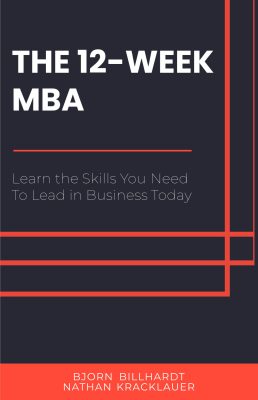
The 12-Week MBA by Bjorn Billhardt and Nathan Kracklauer is a groundbreaking guide that distills the essence of a traditional MBA program into a concise, accessible format. This book promises to equip readers with the core business skills typically gained from a full-fledged MBA, but in just 12 weeks. Billhardt and Kracklauer have crafted a unique approach that combines practical insights with theoretical knowledge, offering a fast-track route to business acumen. The book stands out in the crowded business education genre by providing a structured, time-efficient alternative to formal business school education, making it an invaluable resource for aspiring leaders and entrepreneurs who seek to enhance their business prowess without the time and financial investment of a traditional MBA program.
The 12-Week MBA is primarily aimed at ambitious professionals who aspire to climb the corporate ladder or launch their own businesses but lack the time or resources to commit to a full MBA program. This includes mid-level managers seeking to enhance their leadership skills, entrepreneurs looking to solidify their business acumen, and recent graduates aiming to fast-track their careers. The book is also well-suited for small business owners who want to gain a more comprehensive understanding of business principles. The authors have crafted the content to be accessible to readers with varying levels of business experience, using clear language and practical examples to explain complex concepts. While the book assumes some basic understanding of business terminology, it strives to break down advanced topics in a way that is digestible for those without formal business education, making it a valuable resource for a wide range of professionals seeking to enhance their business skills.
Is it possible to compress years of business education into just 12 weeks? Bjorn Billhardt and Nathan Kracklauer boldly claim it is in their book The 12-Week MBA: Learn the Skills You Need to Lead in Business Today. This audacious premise challenges the traditional notion that mastering business acumen requires years of study and six-figure tuition fees. But can such a condensed approach truly deliver on its promise?
The authors present a meticulously structured program that covers the fundamental pillars of business education. Each week focuses on a critical area of business knowledge, from finance and marketing to strategy and leadership. Billhardt and Kracklauer have distilled the essence of MBA coursework, eliminating academic fluff and concentrating on practical, applicable skills that today’s business leaders need.
The 12-Week MBA doesn’t just skim the surface. It dives deep into each topic, providing readers with a solid foundation in business principles. The book combines theoretical frameworks with real-world case studies, allowing readers to see how concepts apply in actual business scenarios. This approach bridges the gap between academic knowledge and practical application, a common criticism of traditional MBA programs.
One of the book’s strengths lies in its emphasis on modern business challenges. Billhardt and Kracklauer recognize that the business landscape is rapidly evolving, and they’ve tailored their content accordingly. Readers will find chapters dedicated to digital transformation, sustainability, and global business environments – topics that are increasingly crucial in today’s corporate world.
By reading The 12-Week MBA, aspiring business leaders will gain a comprehensive understanding of core business concepts, develop critical thinking skills for strategic decision-making, learn to analyze financial statements and make data-driven decisions, master the fundamentals of marketing and branding in the digital age, and hone their leadership and team management abilities. The book also promises to enhance readers’ problem-solving skills through case studies and practical exercises, preparing them for real-world business challenges.
The central thesis of The 12-Week MBA is that the essential knowledge and skills taught in a traditional MBA program can be effectively condensed and learned in a fraction of the time. Billhardt and Kracklauer argue that by focusing on the most critical and practical aspects of business education, individuals can rapidly develop the competencies needed to succeed in today’s fast-paced business environment.
This core message challenges the conventional wisdom surrounding business education. It’s akin to claiming that one can become a skilled chef by mastering a handful of fundamental techniques and recipes, rather than spending years in culinary school. The authors posit that by understanding key business principles and how to apply them, readers can achieve a level of business acumen comparable to that of MBA graduates.
However, the book doesn’t suggest that this approach completely replaces the value of a full MBA program. Instead, it positions itself as a powerful alternative for those who need to acquire business skills quickly or can’t commit to a traditional MBA. The authors emphasize that continuous learning and practical application are key to truly mastering business leadership.
The 12-Week MBA has made waves in the business education community since its release. Its approach challenges the status quo of business schools and online MBA programs, sparking debates about the future of business education. Some traditionalists argue that the complexities of business can’t be adequately covered in such a short time frame, while others praise the book for democratizing access to business knowledge.
The book’s impact extends beyond individual readers. Some companies have incorporated it into their leadership development programs, using it as a framework to upskill their managers. This corporate adoption speaks to the practical value of the content and its relevance to real-world business challenges.
Critics of the book point out that it can’t replicate the networking opportunities and in-depth specializations offered by full MBA programs. However, proponents argue that in a rapidly changing business landscape, the ability to quickly acquire and apply new skills is often more valuable than a traditional degree.
The significance of The 12-Week MBA lies not just in its content, but in its challenge to the educational status quo. It raises important questions about the most effective ways to develop business leaders in the 21st century. As the business world continues to evolve at a breakneck pace, Billhardt and Kracklauer’s approach suggests that education must evolve too, becoming more agile and focused on practical skills.
While it hasn’t received major awards, the book has garnered recognition from business leaders and educators. Several top business schools have acknowledged its value as a supplementary resource for their students. Its growing popularity and the discussions it has sparked in business circles underscore its significance in the ongoing conversation about the future of business education.
After thoroughly examining The 12-Week MBA by Bjorn Billhardt and Nathan Kracklauer, we find it to be a valuable resource for individuals seeking a comprehensive introduction to core business concepts. The book’s strength lies in its ability to distill complex MBA-level material into an accessible, structured format that can be completed in a relatively short timeframe.
We appreciate the authors’ efforts to provide a well-rounded business education, covering essential topics such as finance, marketing, strategy, and leadership. The practical exercises and real-world examples included throughout the book enhance its applicability, allowing readers to immediately apply their newfound knowledge in their professional lives.
The book’s emphasis on both hard and soft skills is commendable. By addressing not only technical business concepts but also crucial leadership and communication skills, Billhardt and Kracklauer have created a resource that can benefit professionals at various stages of their careers.
We also value the book’s focus on contemporary business challenges, such as digital transformation and global business practices. This up-to-date content ensures that readers are equipped with relevant knowledge for today’s rapidly evolving business landscape.
However, we must note that the book’s compressed format necessarily sacrifices some depth in certain areas. While it provides a solid foundation, readers seeking specialized knowledge in specific business disciplines may need to supplement their learning with additional resources.
Additionally, we caution readers against viewing The 12-Week MBA as a complete substitute for a traditional MBA program. While the book offers valuable insights and practical skills, it cannot replicate the networking opportunities, in-depth discussions, and comprehensive project work that are integral to full-time MBA programs.
Our Recommendation
We recommend The 12-Week MBA to professionals who are looking to broaden their business knowledge, aspiring entrepreneurs seeking a foundational understanding of business principles, and individuals considering pursuing an MBA who want to get a taste of the curriculum before committing to a full program.
For those who already have a strong business background or are seeking highly specialized knowledge, we suggest using this book as a refresher or supplementing it with more advanced, topic-specific resources. Ultimately, we believe The 12-Week MBA offers significant value as an efficient, practical guide to essential business concepts, making it a worthwhile investment for anyone looking to enhance their business acumen in a structured, time-efficient manner.
The essence of The 12-Week MBA by Bjorn Billhardt and Nathan Kracklauer lies in its comprehensive coverage of core business disciplines, distilled into a 12-week program. The book focuses on key areas that form the backbone of business education, each representing a critical component of the overall business landscape.
Financial acumen stands at the forefront of the book’s curriculum. The authors emphasize the importance of understanding financial statements, budgeting, and financial forecasting. They argue that a strong grasp of finance is crucial for making informed business decisions, regardless of one’s specific role within an organization. The book guides readers through the process of interpreting balance sheets, income statements, and cash flow statements, providing tools to assess a company’s financial health and performance.
Marketing strategy is another pivotal topic covered in depth. Billhardt and Kracklauer stress the importance of understanding customer needs, market segmentation, and brand positioning. They explore both traditional and digital marketing techniques, acknowledging the shifting landscape of consumer engagement in the digital age. The book offers frameworks for developing comprehensive marketing plans and measuring their effectiveness, emphasizing the need for data-driven decision-making in marketing efforts.
Strategic thinking and competitive analysis form a crucial part of the book’s essence. The authors introduce various strategic frameworks and teach readers how to analyze competitive landscapes. They emphasize the importance of developing a clear vision for an organization and aligning all activities towards achieving that vision. The book covers topics such as SWOT analysis, Porter’s Five Forces, and blue ocean strategy, providing readers with tools to assess market opportunities and threats.
Leadership and organizational behavior represent another key area of focus. The authors argue that understanding human dynamics is crucial for effective leadership. They explore topics such as motivation theory, team dynamics, and organizational culture. The book provides strategies for effective communication, conflict resolution, and change management, emphasizing the importance of emotional intelligence in leadership roles.
Operations management and supply chain optimization are also central to the book’s message. The authors stress the importance of efficient processes in creating value for customers and maintaining a competitive edge. They cover topics such as lean management, quality control, and supply chain logistics. The book emphasizes the need for continuous improvement and adaptability in operational processes to meet changing market demands.
Innovation and entrepreneurship form another critical component of the book’s essence. Billhardt and Kracklauer argue that in today’s fast-paced business environment, the ability to innovate and adapt is crucial for long-term success. They provide frameworks for fostering innovation within organizations and discuss the challenges and opportunities of launching new ventures. The book covers topics such as design thinking, agile methodologies, and business model innovation.
Ethical decision-making and corporate social responsibility are woven throughout the book’s content. The authors emphasize the importance of considering the broader impact of business decisions on society and the environment. They argue that sustainable business practices are not just ethically important but also crucial for long-term business success. The book provides frameworks for ethical decision-making and explores case studies of companies balancing profit with social responsibility.
Financial Analysis in Action: Apple Inc.: The book uses Apple Inc. as a case study to illustrate financial analysis techniques. Readers are guided through the process of examining Apple’s financial statements, calculating key ratios, and interpreting the results. This example helps readers understand how financial data can provide insights into a company’s performance, efficiency, and growth prospects.
Marketing Strategy: Nike’s “Just Do It” Campaign: To illustrate effective brand positioning and marketing strategy, the authors analyze Nike’s iconic “Just Do It” campaign. They explore how Nike identified its target market, developed a compelling brand message, and consistently communicated this message across various channels. This example demonstrates the power of aligning marketing efforts with brand values and customer aspirations.
Competitive Strategy: Netflix vs. Blockbuster: The book uses the case of Netflix’s disruption of Blockbuster to illustrate the importance of strategic thinking and adapting to changing market conditions. It analyzes how Netflix identified a gap in the market, leveraged new technology, and continuously innovated its business model. This example highlights the consequences of failing to anticipate and respond to disruptive threats.
Leadership in Practice: Microsoft’s Cultural Transformation: To demonstrate effective leadership and organizational change, the book examines Satya Nadella’s transformation of Microsoft’s culture. It explores how Nadella shifted the company’s focus from a “know-it-all” to a “learn-it-all” mindset, fostering innovation and collaboration. This example illustrates the impact of leadership on organizational culture and performance.
Operations Management: Toyota Production System: The authors use Toyota’s renowned production system as an example of efficient operations management. They explore the principles of lean manufacturing, just-in-time production, and continuous improvement that form the core of Toyota’s approach. This case study demonstrates how operational excellence can lead to sustained competitive advantage.
Innovation and Entrepreneurship: Airbnb’s Disruptive Model: To illustrate innovative thinking and entrepreneurship, the book analyzes Airbnb’s disruptive business model. It examines how the company identified an untapped market opportunity, leveraged technology to connect hosts and guests, and scaled its platform globally. This example showcases how innovative ideas can challenge established industries and create new markets.
Ethical Decision-Making: Patagonia’s Sustainability Initiatives: The book uses Patagonia’s commitment to sustainability as an example of ethical business practices. It explores how the company has integrated environmental and social responsibility into its core business model, from sourcing materials to advocating for environmental causes. This case study demonstrates how businesses can balance profit with purpose and gain customer loyalty through ethical practices.
In The 12-Week MBA, Billhardt and Kracklauer emphasize that financial literacy is not just for accountants and CFOs, but a crucial skill for all business leaders. They suggest that every professional should be able to read and interpret financial statements, understand key financial ratios, and make data-driven decisions based on financial information. To apply this insight, start by regularly reviewing your company’s financial reports. Practice calculating and interpreting key ratios such as the current ratio, debt-to-equity ratio, and return on investment. Use tools like Excel to create financial models for decision-making, such as break-even analysis for new product launches or net present value calculations for potential investments. By honing these skills, you’ll be better equipped to contribute to strategic discussions and make informed business decisions.
The authors stress the importance of putting the customer at the center of all marketing efforts. They argue that successful marketing isn’t about pushing products, but about understanding and meeting customer needs. To apply this insight, start by creating detailed customer personas for your target audience. Conduct regular surveys and focus groups to understand their pain points, desires, and buying behaviors. Use this information to tailor your product offerings and marketing messages. Implement a customer relationship management (CRM) system to track customer interactions and preferences. Regularly analyze this data to identify trends and opportunities for personalization. Experiment with different marketing channels and messages, always measuring the impact on customer engagement and conversion rates. By consistently focusing on customer needs, you can create more effective marketing campaigns and build stronger customer relationships.
Billhardt and Kracklauer challenge the notion that strategic thinking is an innate ability, arguing instead that it’s a skill that can be developed through practice and the application of specific frameworks. They provide a structured approach to strategic analysis and decision-making. To apply this insight, start by regularly using strategic frameworks like SWOT analysis, Porter’s Five Forces, or the Business Model Canvas to analyze your company and its competitive landscape. Set aside time each week for strategic thinking, where you step back from day-to-day operations to consider long-term goals and challenges. Practice scenario planning by imagining different future states for your industry and brainstorming how your company could respond. Engage in regular strategy sessions with your team, encouraging diverse perspectives and challenging assumptions. By making strategic thinking a habit, you can improve your ability to anticipate changes, identify opportunities, and make better long-term decisions for your organization.
The book emphasizes that technical skills alone are not enough for effective leadership. Emotional intelligence – the ability to understand and manage your own emotions and those of others – is crucial for leading teams and organizations. To apply this insight, start by assessing your own emotional intelligence. Pay attention to your emotional reactions in various situations and practice self-regulation techniques like deep breathing or mindfulness. Work on improving your empathy by actively listening to your team members and trying to understand their perspectives. Practice giving constructive feedback that addresses both performance and emotional aspects. Invest in leadership training programs that focus on emotional intelligence skills such as conflict resolution, motivating others, and building trust. By developing your emotional intelligence, you can become a more effective leader who inspires and empowers your team.
Billhardt and Kracklauer argue that in today’s competitive business environment, operational excellence can be a key differentiator. They stress the importance of continuously improving processes and eliminating waste. To apply this insight, start by mapping out your key business processes and identifying bottlenecks or inefficiencies. Implement lean management principles such as value stream mapping and the 5S methodology (Sort, Set in Order, Shine, Standardize, Sustain) to streamline operations. Encourage a culture of continuous improvement by setting up suggestion systems and rewarding employees for process innovations. Use data analytics to track key performance indicators (KPIs) and identify areas for improvement. Consider implementing technologies like robotic process automation (RPA) or artificial intelligence (AI) to automate repetitive tasks and improve efficiency. By focusing on operational excellence, you can reduce costs, improve quality, and enhance customer satisfaction.
The authors challenge the myth of innovation as a mysterious, unpredictable process. Instead, they present innovation as a systematic approach that can be learned and implemented. To apply this insight, establish a structured innovation process in your organization. Start by creating cross-functional innovation teams and providing them with the time and resources to explore new ideas. Implement design thinking methodologies, starting with empathy for the user, defining problems clearly, ideating multiple solutions, prototyping quickly, and testing rigorously. Set up an idea management system where employees can submit and vote on innovative ideas. Allocate a portion of your budget specifically for innovation projects. Create metrics to measure your innovation efforts, such as the number of new ideas generated, prototypes created, or successful launches. By treating innovation as a systematic process, you can increase your organization’s ability to generate and implement new ideas.
The 12-Week MBA emphasizes that ethical considerations should be at the core of all business decisions. The authors argue that ethical behavior not only protects a company’s reputation but also contributes to long-term success. To apply this insight, start by clearly defining and communicating your company’s ethical standards and values. Develop a formal code of ethics and ensure all employees are trained on it. Implement an ethics hotline or reporting system where employees can safely report ethical concerns. When making decisions, use ethical frameworks such as the utilitarian approach (considering the greatest good for the greatest number) or the rights approach (respecting the rights of all affected parties). Regularly conduct ethical audits of your business practices, especially in areas like supply chain management, marketing claims, and employee treatment. By prioritizing ethical decision-making, you can build trust with stakeholders, reduce legal risks, and create a positive corporate culture.
Billhardt and Kracklauer stress the importance of developing a global mindset in today’s interconnected business world. They argue that understanding different cultures, economies, and business practices is crucial for success in the global marketplace. To apply this insight, start by staying informed about global economic and political trends. Read international business publications and follow thought leaders from different regions on social media. If possible, seek out opportunities for international assignments or cross-cultural projects within your organization. Learn a new language or take courses on cross-cultural communication. When entering new markets, conduct thorough research on local business practices, consumer preferences, and regulatory environments. Build relationships with local partners or consultants who can provide on-the-ground insights. By developing global business awareness, you can identify new opportunities, navigate cross-cultural challenges, and make more informed decisions in an international business context.
The 12-Week MBA excels in providing a comprehensive overview of essential business concepts. Billhardt and Kracklauer have skillfully distilled the core elements of a traditional MBA program into a concise format without sacrificing depth. The book covers a wide range of topics, including finance, marketing, strategy, operations, and leadership, giving readers a well-rounded understanding of business fundamentals. Each chapter builds upon the previous ones, creating a cohesive learning experience that mirrors the integrated nature of business operations. This comprehensive approach ensures that readers gain a holistic view of how different business functions interact and contribute to overall organizational success.
One of the book’s greatest strengths lies in its focus on practical application. The authors go beyond merely explaining concepts; they provide concrete strategies and tools that readers can immediately implement in their professional lives. Each chapter includes exercises, worksheets, and real-world examples that help translate theory into practice. For instance, the finance chapter not only explains financial statements but also guides readers through the process of analyzing them using key ratios and metrics. This hands-on approach makes the book particularly valuable for professionals looking to enhance their skills and apply them in their current roles.
Billhardt and Kracklauer have managed to present complex business concepts in a clear, accessible manner. Their writing style is engaging and conversational, making even traditionally dry topics like accounting more approachable. They use analogies and real-world examples to illustrate abstract concepts, helping readers grasp difficult ideas more easily. The authors also incorporate storytelling elements, weaving in case studies and anecdotes from successful businesses to keep readers engaged. This approach not only makes the book more enjoyable to read but also aids in retention of the material.
The 12-Week MBA stands out for its inclusion of contemporary business challenges and trends. The authors have gone beyond traditional MBA topics to address issues highly relevant in today’s business landscape, such as digital transformation, sustainability, and global business in an interconnected world. For example, the marketing chapter doesn’t just cover traditional marketing concepts but also delves into digital marketing strategies and the use of data analytics in customer acquisition and retention. This focus on current trends ensures that readers are equipped with knowledge and skills that are immediately applicable in today’s rapidly evolving business environment.
While many business books focus solely on hard skills, The 12-Week MBA recognizes the critical importance of soft skills in business success. The authors dedicate significant attention to topics such as emotional intelligence, effective communication, and leadership development. They provide frameworks for understanding team dynamics, managing conflicts, and motivating employees. This balanced approach between hard and soft skills makes the book particularly valuable for aspiring leaders who need to develop a well-rounded skill set to succeed in management roles.
The book’s 12-week structure provides a clear, manageable learning path for readers. Each week focuses on a specific business area, with clear learning objectives, key concepts, and practical exercises. This structured approach allows readers to pace their learning and systematically build their knowledge and skills over time. The authors also include review sections and self-assessment tools, enabling readers to track their progress and reinforce their learning. This well-organized format makes the book suitable for self-study, allowing busy professionals to effectively manage their learning alongside their work commitments.
While the book’s comprehensive coverage is a strength, it also leads to a potential weakness. By attempting to cover all aspects of an MBA in just 12 weeks, The 12-Week MBA necessarily sacrifices depth in certain areas. For professionals looking to specialize in a particular field, such as finance or marketing, the book may not provide sufficient depth of knowledge. Complex topics that typically require extensive study in traditional MBA programs are condensed into single chapters, which may leave some readers wanting more detailed information. This limitation could be particularly noticeable for readers who already have a strong foundation in business and are looking for advanced insights in specific areas.
The 12-Week MBA prioritizes practical application over academic theory, which may be a drawback for readers seeking a more scholarly approach. While the book references key business theories and models, it doesn’t always provide in-depth explanations of their origins, limitations, or academic debates surrounding them. The authors often present simplified versions of complex theories, which, while making the content more accessible, may not fully capture the nuances and complexities of these ideas. Readers looking for a rigorous academic treatment of business concepts might find the book lacking in this regard.
In their effort to make complex business concepts accessible, Billhardt and Kracklauer occasionally risk oversimplifying some topics. For instance, the book’s treatment of topics like international business strategy or corporate finance might not fully capture the complexities and challenges involved in these areas. While this approach makes the content more digestible for beginners, it could lead to an overly simplistic understanding of complex business issues. Readers may need to supplement their learning with additional resources to gain a more nuanced understanding of certain topics.
While the book does include some case studies and examples, there’s room for more diverse and in-depth real-world applications. The examples provided tend to focus on well-known, large corporations, which may not be as relevant or applicable for readers working in small businesses or startups. Additionally, the case studies are often brief and used primarily to illustrate specific points rather than providing comprehensive analyses of business situations. More varied and detailed case studies could have enhanced the book’s practical value and helped readers better understand how to apply the concepts in different business contexts.
One potential blind spot in The 12-Week MBA is the implication that a comprehensive business education can be fully acquired in just 12 weeks. While the book provides a solid foundation, it may inadvertently lead readers to underestimate the complexity and nuance of certain business concepts. In reality, mastering these skills often requires more time, practice, and real-world application than a 12-week program can provide. This rapid-learning approach might create a false sense of mastery, potentially leading to overconfidence in business decision-making. Readers should be aware that the book offers a starting point rather than a complete business education. For a more in-depth exploration of the time and effort required to develop true business acumen, readers might consider The Personal MBA by Josh Kaufman, which emphasizes self-directed, long-term learning, or Mastery by Robert Greene, which discusses the extensive time and practice required to truly master any skill, including business leadership.
While The 12-Week MBA provides a broad overview of business principles, it may not adequately address the unique challenges and nuances of specific industries. The book’s generalized approach, while valuable for building a foundational understanding, might lead readers to overlook critical industry-specific factors that can significantly impact business strategy and operations. For instance, the regulatory environment in healthcare, the rapid technological changes in the tech sector, or the sustainability challenges in manufacturing are not extensively covered. This blind spot could potentially lead to the misapplication of general principles in specialized contexts. To complement this broader view, readers might benefit from industry-specific resources such as The Innovator’s Prescription by Clayton Christensen for healthcare, The Lean Startup by Eric Ries for technology and innovation, or Green to Gold by Daniel Esty and Andrew Winston for sustainability in business.
While The 12-Week MBA touches on leadership and organizational behavior, it may not fully explore the critical role that organizational culture plays in business success. The book’s focus on individual skills and strategies might lead readers to underestimate the impact of company culture on everything from strategy implementation to employee performance and innovation. This oversight could result in readers focusing too heavily on personal skill development while neglecting the broader cultural context in which these skills are applied. The importance of understanding and shaping organizational culture cannot be overstated in today’s business environment. For a deeper dive into this crucial aspect, readers might turn to The Culture Code by Daniel Coyle, which explores how great organizations build and sustain their cultures, or Organizational Culture and Leadership by Edgar Schein, which provides a comprehensive framework for understanding and influencing organizational culture.
While The 12-Week MBA does address ethical decision-making, it may not fully capture the growing importance of corporate social responsibility (CSR) and sustainable business practices in today’s business landscape. The book’s traditional business focus might lead readers to underestimate the impact of social and environmental factors on long-term business success. This blind spot could result in a narrow view of business objectives, focusing primarily on financial metrics while overlooking the broader societal impact of business decisions. In an era where consumers, employees, and investors increasingly value ethical and sustainable business practices, this oversight could lead to reputational risks and missed opportunities. To gain a more comprehensive understanding of the role of ethics and CSR in modern business, readers might explore Corporate Social Responsibility: Doing the Most Good for Your Company and Your Cause by Philip Kotler and Nancy Lee, which provides a strategic approach to CSR, or Conscious Capitalism by John Mackey and Raj Sisodia, which argues for a more holistic, stakeholder-oriented approach to business.
While The 12-Week MBA provides a solid foundation of business knowledge, it may not sufficiently stress the importance of adaptability and continuous learning in today’s rapidly changing business environment. The book’s structured, comprehensive approach might inadvertently create the impression that business knowledge is static, potentially leading readers to underestimate the need for ongoing learning and adaptation. In reality, business practices, technologies, and market conditions are constantly evolving, requiring leaders to continually update their skills and knowledge. This blind spot could result in a fixed mindset, where readers believe they have ‘completed’ their business education after finishing the book. To address this, readers might benefit from exploring Mindset: The New Psychology of Success by Carol S. Dweck, which emphasizes the importance of a growth mindset in personal and professional development, or The Start-Up of You by Reid Hoffman and Ben Casnocha, which applies entrepreneurial principles to career development and emphasizes the need for continuous adaptation and learning in one’s professional life.
The 12-Week MBA shares similarities with Josh Kaufman’s The Personal MBA in its attempt to distill MBA-level knowledge into an accessible format. Both books aim to provide a comprehensive business education outside of traditional academic settings. However, Kaufman’s approach is less structured, offering a collection of business concepts without a specific timeline for learning. While The 12-Week MBA provides a more guided, step-by-step learning experience, The Personal MBA offers greater flexibility for self-paced learning. Kaufman’s book also places a stronger emphasis on self-education and the idea that formal business education isn’t necessary for business success. In contrast, Billhardt and Kracklauer’s work seems to position itself as a condensed version of traditional MBA programs rather than an alternative philosophy of business education.
Steven Silbiger’s The Ten-Day MBA is perhaps the closest comparison to The 12-Week MBA in terms of structure and intent. Both books aim to compress MBA-level education into a short, accessible format. However, Silbiger’s book, as the title suggests, proposes an even more condensed timeframe. While this might appeal to readers looking for an even quicker overview, it necessarily sacrifices some of the depth and practical application exercises that Billhardt and Kracklauer include in their 12-week format. The Ten-Day MBA also tends to focus more on hard skills and quantitative analysis, while The 12-Week MBA appears to offer a more balanced approach, including significant coverage of soft skills and leadership development.
Mark McCormack’s What They Don’t Teach You at Harvard Business School offers an interesting contrast to The 12-Week MBA. While Billhardt and Kracklauer attempt to replicate the core curriculum of business school, McCormack focuses on the practical, often intangible skills that he argues are not taught in formal business education. McCormack’s book is less structured and more anecdotal, drawing heavily on the author’s personal experiences in business. While The 12-Week MBA provides a more comprehensive overview of business fundamentals, McCormack’s book offers valuable insights into the softer aspects of business success, such as people skills, negotiation tactics, and intuitive decision-making. Readers might find that these books complement each other, with McCormack’s work filling in some of the experiential gaps in Billhardt and Kracklauer’s more academic approach.
While not strictly an MBA-in-a-book, Osterwalder and Pigneur’s Business Model Generation offers a unique perspective on business strategy that serves as an interesting comparison to The 12-Week MBA. This book focuses intensively on the process of designing and innovating business models, using visual thinking techniques and practical exercises. While The 12-Week MBA covers a broader range of topics, Business Model Generation dives much deeper into the specific area of business model innovation. Billhardt and Kracklauer’s book provides a more traditional, comprehensive view of business, while Osterwalder and Pigneur offer a more specialized, design-thinking approach to strategy. Readers might find that Business Model Generation offers a valuable supplement to the strategy portions of The 12-Week MBA, providing a more hands-on, creative approach to business planning.
Apply Financial Literacy Skills
Implement Customer-Centric Marketing Strategies
Enhance Strategic Thinking Skills
Develop Emotional Intelligence
Focus on Operational Excellence
Foster Innovation
Prioritize Ethical Decision-Making
Develop Global Business Awareness
Implement a Company-Wide Financial Literacy Program
The 12-Week MBA emphasizes the importance of financial literacy across all levels of an organization. Businesses can leverage this insight by implementing a company-wide financial literacy program. This initiative would involve training sessions on reading financial statements, understanding key financial ratios, and making data-driven financial decisions. By improving financial literacy throughout the organization, companies can foster better decision-making, enhance budget management, and improve overall financial performance.
However, implementing such a program may face several challenges. Employees may be resistant to learning about finance, viewing it as outside their job scope or too complex. There may also be time constraints, as employees balance their regular duties with additional training. Furthermore, different departments may require varying levels of financial knowledge, making it difficult to design a one-size-fits-all program.
To overcome these challenges, businesses can adopt a tiered approach to financial literacy training. Start with basic concepts for all employees, then offer more advanced modules for those in decision-making roles. Utilize e-learning platforms to allow flexible, self-paced learning. Incorporate real company data and case studies to make the training more relevant and engaging. Finally, incentivize participation by linking financial literacy to performance reviews or offering certifications upon completion.
Develop a Customer-Centric Culture
The book stresses the importance of putting the customer at the center of all business activities. Organizations can apply this principle by developing a customer-centric culture. This involves reorienting processes, policies, and metrics to prioritize customer needs and satisfaction. It may include regular customer feedback sessions, empowering front-line employees to make customer-focused decisions, and incorporating customer satisfaction metrics into performance evaluations.
Shifting to a customer-centric culture can be challenging, especially for established organizations with ingrained processes. Employees may resist changes to familiar workflows, and departments may struggle to break down silos that hinder a unified customer experience. There may also be short-term financial pressures as the organization invests in new systems or processes to support this cultural shift.
To address these challenges, businesses should start by clearly communicating the vision and benefits of a customer-centric approach. Provide training on customer service skills and empathy across all departments, not just customer-facing roles. Implement cross-functional teams to break down silos and encourage collaboration. Use customer journey mapping to identify pain points and opportunities for improvement. Finally, align incentives and KPIs with customer satisfaction metrics to reinforce the importance of this cultural shift.
Foster a Culture of Continuous Learning and Innovation
The 12-Week MBA underscores the importance of innovation and adaptability in today’s fast-paced business environment. Organizations can apply this principle by fostering a culture of continuous learning and innovation. This could involve setting up innovation labs, implementing idea management systems, allocating time for employees to work on innovative projects, and providing resources for continuous learning and skill development.
However, creating such a culture can be challenging. Employees may be hesitant to take risks or propose new ideas for fear of failure. Time constraints and pressure to meet short-term goals can overshadow long-term innovation efforts. There may also be resistance from middle management who are focused on maintaining current operations.
To overcome these obstacles, organizations can start by creating a safe environment for idea sharing and experimentation. Implement a “no-blame” policy for failed innovations to encourage risk-taking. Allocate a specific percentage of work time (e.g., 15%) for innovative projects or learning activities. Provide resources such as online learning platforms or innovation workshops. Recognize and reward innovative efforts, not just successful outcomes. Finally, ensure that leadership actively participates in and champions these initiatives to signal their importance throughout the organization.
Enhance Strategic Thinking Capabilities
The book emphasizes the importance of strategic thinking skills for business success. Organizations can apply this by enhancing strategic thinking capabilities across all levels. This could involve regular strategy sessions, training on strategic frameworks, and encouraging employees to consider long-term impacts and broader business contexts in their decision-making.
Implementing this can be challenging as many employees, especially those in operational roles, may not be accustomed to thinking strategically. There may be a tendency to focus on immediate tasks rather than long-term goals. Additionally, information silos within the organization can hinder the holistic thinking required for effective strategy formulation.
To address these challenges, organizations can start by providing training on strategic thinking tools and frameworks. Incorporate strategic considerations into regular team meetings and decision-making processes. Encourage cross-functional collaboration to break down information silos. Implement a mentoring program where senior leaders can guide others in developing strategic thinking skills. Finally, create opportunities for employees at all levels to participate in strategic planning sessions, fostering a sense of ownership and improving the quality of strategic decisions.
Prioritize Ethical Decision-Making and Corporate Social Responsibility
The 12-Week MBA highlights the growing importance of ethical business practices and corporate social responsibility. Organizations can apply this by prioritizing ethical decision-making and integrating CSR into their core business strategy. This could involve developing a strong code of ethics, implementing ethical training programs, setting up ethics committees, and actively engaging in social and environmental initiatives.
However, implementing strong ethical practices and CSR initiatives can be challenging. There may be short-term financial pressures that conflict with ethical or socially responsible choices. Some stakeholders may resist changes that they perceive as potentially impacting profitability. There could also be difficulties in measuring the impact of CSR initiatives, making it hard to justify their value to skeptical stakeholders.
To overcome these challenges, organizations should start by clearly articulating the long-term benefits of ethical practices and CSR, including enhanced reputation, increased customer loyalty, and improved employee satisfaction. Integrate ethical considerations and CSR goals into the company’s mission statement and strategic plans. Provide comprehensive ethics training for all employees and include ethical behavior in performance evaluations. Develop clear metrics for measuring the impact of CSR initiatives, both in terms of social/environmental impact and business benefits. Finally, celebrate and publicize ethical decisions and CSR successes to reinforce their importance within the organization and to external stakeholders.
Develop Global Business Competence
The book emphasizes the importance of global business awareness in today’s interconnected world. Organizations can apply this by developing global business competence across the company. This could involve providing cultural awareness training, offering language learning programs, creating international assignment opportunities, and fostering partnerships with international organizations.
Implementing global business competence can face several challenges. There may be resistance from employees who are comfortable with domestic operations and hesitant about international expansion. Language barriers and cultural misunderstandings can lead to communication issues and missed opportunities. There could also be legal and regulatory complexities in operating across different countries.
To address these challenges, organizations can start by clearly communicating the importance of global competence for the company’s future success. Provide comprehensive cultural awareness training, including both general principles and country-specific information. Offer language learning resources and incentivize employees to develop language skills relevant to key markets. Create a mentoring program pairing employees with international experience with those new to global business. Develop a robust support system for employees on international assignments, including pre-departure training and ongoing support. Finally, foster a culture of curiosity and openness to different perspectives, encouraging employees to learn from and adapt to diverse business environments.
The 12-Week MBA aligns with the growing trend of micro-credentials in education. As traditional degrees face scrutiny for their cost and time investment, bite-sized learning options are gaining popularity. This book’s condensed approach to MBA education fits perfectly into this trend.
In the future, we might see more specialized versions of such condensed programs. These could focus on specific industries or skill sets. Employers may start recognizing these micro-credentials as valid alternatives to traditional degrees. This shift could democratize business education, making it more accessible to a wider audience.
The book’s comprehensive yet concise approach to business education supports the rise of the gig economy and entrepreneurship. As more people opt for freelance work or start their own businesses, there’s an increasing need for broad business knowledge.
The 12-Week MBA provides a toolkit for these independent professionals. It offers the essential skills needed to run a business without the time commitment of a full degree. In the future, we might see more resources tailored specifically for gig workers and entrepreneurs. These could include modules on personal branding, contract negotiation, and digital marketing.
As AI continues to advance, it will likely impact how we approach business education. The condensed format of The 12-Week MBA could serve as a foundation for AI-enhanced learning experiences.
In the future, AI could personalize the learning journey based on an individual’s strengths, weaknesses, and career goals. It might provide real-time case studies and simulations based on current market conditions. The core concepts from books like The 12-Week MBA could be augmented with AI-driven, up-to-the-minute business insights.
The book’s emphasis on ethical decision-making aligns with the growing focus on sustainability and corporate social responsibility. As consumers and investors increasingly demand ethical business practices, this aspect of the book will likely become even more relevant.
In the future, we might see entire courses or books dedicated to sustainable business practices. The condensed MBA format could evolve to include more in-depth coverage of topics like environmental impact assessment, ethical supply chain management, and stakeholder engagement.
The 12-Week MBA‘s inclusion of global business awareness reflects the trend towards increasingly global and remote business operations. As companies continue to expand internationally and remote work becomes more common, these skills will be crucial.
Future iterations of condensed MBA programs might place even greater emphasis on cross-cultural communication and managing remote teams. We could see the development of virtual reality simulations for international business scenarios. These would allow learners to practice global business skills in immersive, realistic environments.
The 12-Week MBA by Billhardt and Kracklauer represents a significant trend in business education towards more accessible, condensed learning formats. This shift has broader implications for both the business education landscape and the wider business world.
In the short term, books like The 12-Week MBA may contribute to the democratization of business education. By making MBA-level concepts more accessible to a wider audience, these resources could help level the playing field in business, allowing individuals who can’t afford or commit to traditional MBA programs to gain valuable knowledge and skills. This could lead to increased innovation and entrepreneurship, as more people gain the confidence and tools to start and grow businesses.
However, the rise of condensed business education resources also raises questions about the future role of traditional MBA programs. If high-quality business education becomes widely available in more accessible formats, business schools may need to evolve their offerings to justify their cost and time investment. This could lead to a greater emphasis on networking, practical experience, and specialized knowledge in MBA programs, as opposed to general business education.
In the long term, the popularity of books like The 12-Week MBA could influence hiring practices and career progression in the business world. Companies might place less emphasis on formal MBA credentials and more on demonstrated skills and knowledge. This shift could lead to more diverse leadership in businesses, as the path to executive positions becomes more varied and accessible.
Moreover, the condensed, practical approach to business education exemplified by The 12-Week MBA could influence how businesses approach training and development. Companies might adopt similar models for internal training programs, focusing on rapid skill acquisition and immediate application of knowledge.
Looking ahead, the impact of books like The 12-Week MBA will likely depend on how well they can adapt to the rapidly changing business landscape. As new technologies, business models, and global challenges emerge, these resources will need to continuously update their content to remain relevant. The success of this model of business education may also spur the development of more specialized, industry-specific versions of condensed business education resources.
Ultimately, while books like The 12-Week MBA are unlikely to completely replace traditional business education, they are poised to play an increasingly important role in how business knowledge is disseminated and acquired. Their influence could lead to a more diverse, adaptable, and broadly educated business community, potentially driving innovation and new approaches to longstanding business challenges.
The Lean Startup by Eric Ries: This book offers a valuable complement to The 12-Week MBA by focusing specifically on entrepreneurship and innovation. While Billhardt and Kracklauer provide a broad overview of business concepts, Ries dives deep into the process of building and scaling startups. His emphasis on rapid experimentation, iterative development, and validated learning aligns well with the fast-paced, practical approach of The 12-Week MBA. Readers interested in applying their newly acquired business knowledge to entrepreneurial ventures will find Ries’s methodology particularly useful.
Thinking, Fast and Slow by Daniel Kahneman: Kahneman’s exploration of decision-making processes and cognitive biases provides an excellent companion to the strategic thinking and leadership components of The 12-Week MBA. While Billhardt and Kracklauer offer practical business frameworks, Kahneman delves into the psychological underpinnings of decision-making. This book can help readers understand and overcome common mental pitfalls in business decision-making, enhancing their ability to apply the strategies learned in The 12-Week MBA.
Blue Ocean Strategy by W. Chan Kim and Renée Mauborgne: This book expands on the strategic concepts introduced in The 12-Week MBA by presenting a novel approach to competitive strategy. Kim and Mauborgne argue for creating uncontested market spaces rather than competing in existing ones. Their framework complements the traditional strategy tools presented by Billhardt and Kracklauer, offering readers an additional perspective on how to position their businesses for success in competitive markets.
Influence: The Psychology of Persuasion by Robert B. Cialdini: Cialdini’s exploration of the psychology of persuasion adds depth to the marketing and leadership concepts presented in The 12-Week MBA. While Billhardt and Kracklauer provide an overview of marketing principles, Cialdini offers insights into why certain marketing and leadership techniques are effective. This book can help readers enhance their marketing strategies and leadership skills by understanding the psychological principles underlying human behavior.
The Hard Thing About Hard Things by Ben Horowitz: Horowitz’s book offers a gritty, realistic look at the challenges of running a business, serving as an excellent counterpoint to the more structured approach of The 12-Week MBA. While Billhardt and Kracklauer provide a comprehensive overview of business concepts, Horowitz shares hard-earned lessons from his experience as a CEO. This book can help readers understand how to apply their business knowledge in real-world situations, particularly when facing difficult decisions or unexpected challenges.
Mindset: The New Psychology of Success by Carol S. Dweck: Dweck’s exploration of the growth mindset complements the learning approach advocated in The 12-Week MBA. While Billhardt and Kracklauer focus on specific business skills, Dweck emphasizes the importance of one’s approach to learning and challenges. This book can help readers develop the mindset needed to continually apply and expand upon the knowledge gained from The 12-Week MBA, fostering ongoing personal and professional growth.
The Innovator’s Dilemma by Clayton M. Christensen: Christensen’s analysis of why great companies fail to stay ahead of disruptive innovation provides a crucial addition to the strategic thinking concepts in The 12-Week MBA. While Billhardt and Kracklauer offer a broad view of business strategy, Christensen focuses specifically on the challenges of innovation in established companies. This book can help readers understand the complexities of managing innovation and staying competitive in rapidly changing industries, complementing the more general strategic frameworks presented in The 12-Week MBA.
Harvard Business Review: HBR’s website (https://hbr.org/) offers a wealth of articles, case studies, and research on various business topics. It’s an excellent resource for staying updated on current business trends and deepening knowledge on specific areas covered in The 12-Week MBA.
Coursera: This online learning platform (https://www.coursera.org/) offers numerous business courses from top universities worldwide. Readers can use Coursera to dive deeper into specific topics introduced in the book, such as finance, marketing, or strategy.
MIT OpenCourseWare: MIT’s free online course materials (https://ocw.mit.edu/) include many business and management courses. This resource allows readers to supplement their learning from The 12-Week MBA with in-depth academic content from a world-renowned institution.
World Business Forum: This annual conference brings together global business leaders to discuss current trends and future challenges. Attending or following the proceedings can provide readers with real-world insights that complement the theoretical knowledge gained from The 12-Week MBA.
TED Business: While not a traditional conference, TED’s business-focused talks (https://www.ted.com/topics/business) offer concise, powerful insights from industry leaders and innovators. These talks can help readers connect the concepts from The 12-Week MBA to real-world applications and cutting-edge ideas.
American Management Association: AMA (https://www.amanet.org/) offers a wide range of resources, including seminars, webinars, and publications on various business topics. Membership can provide readers with ongoing learning opportunities to build on the foundation laid by The 12-Week MBA.
Project Management Institute: For readers particularly interested in project management aspects, PMI (https://www.pmi.org/) offers certifications, resources, and networking opportunities that can complement the project management concepts introduced in the book.
HBR IdeaCast: This podcast from Harvard Business Review (https://hbr.org/podcasts/ideacast) features leading thinkers in management, providing insights that can deepen understanding of topics covered in The 12-Week MBA.
Masters of Scale: Hosted by Reid Hoffman, this podcast (https://mastersofscale.com/) explores how companies grow from zero to a gazillion, offering real-world examples that complement the entrepreneurship and strategy concepts in the book.
Financial Accounting: This course from Harvard Business School Online (https://online.hbs.edu/courses/financial-accounting/) can provide a deeper dive into financial concepts introduced in The 12-Week MBA.
Digital Marketing Specialization: Offered by the University of Illinois on Coursera (https://www.coursera.org/specializations/digital-marketing), this course series can expand on the marketing concepts covered in the book, with a focus on digital strategies.
Inside Job: This documentary provides an in-depth look at the 2008 financial crisis, offering context to the financial concepts discussed in The 12-Week MBA and illustrating the real-world implications of financial decisions.
The Social Network: While dramatized, this film about the founding of Facebook offers insights into entrepreneurship, leadership, and the challenges of scaling a startup, complementing the business growth concepts in the book.
Enron: The Smartest Guys in the Room: This documentary explores the collapse of Enron, providing a cautionary tale that underscores the importance of ethical business practices discussed in The 12-Week MBA.


Discover the key takeaways from top non-fiction books in minutes. Get the wisdom you need to succeed fast. Here, learning is quick, engaging, and always at your fingertips.
© 2025 All Rights Reserved.