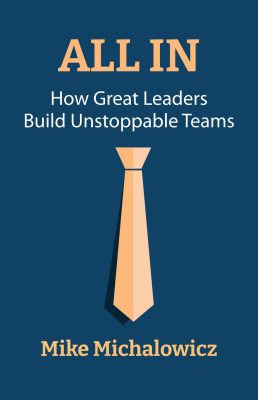
In All In: How Great Leaders Build Unstoppable Teams, Mike Michalowicz presents a groundbreaking approach to leadership and team building. This book is a game-changer for anyone looking to create high-performing, cohesive teams in any industry. Michalowicz draws on his extensive experience as an entrepreneur and business consultant to offer practical, actionable strategies for transforming ordinary groups into extraordinary teams. He challenges conventional wisdom about leadership and team dynamics, providing fresh insights that can revolutionize how organizations operate. All In stands out in the crowded field of leadership literature by focusing on the leader’s role in fostering a team-first mentality and creating an environment where every member is fully committed to the group’s success.
All In is primarily targeted at business leaders, managers, and entrepreneurs who are looking to improve their leadership skills and build more effective teams. The book’s principles are applicable across various industries and organization sizes, making it valuable for both startup founders and executives in large corporations. While the primary audience is those in leadership positions, the book also offers valuable insights for team members who want to contribute to a more cohesive and productive work environment. Michalowicz’s writing style is known for being accessible and engaging, making complex leadership concepts understandable to readers at all levels of business experience. The book’s practical approach and real-world examples make it particularly useful for hands-on leaders who are looking for actionable strategies they can implement immediately in their organizations.
What if the key to building an unstoppable team isn’t about finding the right people, but about creating the right environment? This is the provocative question at the heart of Mike Michalowicz’s All In: How Great Leaders Build Unstoppable Teams. In a world where leadership books often focus on individual traits or management techniques, Michalowicz turns the spotlight on the leader’s role in fostering a team-first mentality.
The book challenges conventional wisdom about team dynamics and leadership. Michalowicz argues that the most effective teams aren’t just collections of talented individuals, but cohesive units where every member is fully committed to the group’s success. He presents a radical idea: that leaders should prioritize the team’s needs over individual achievements, even their own.
Through a series of engaging anecdotes and case studies, Michalowicz illustrates how this approach has transformed struggling businesses into thriving enterprises. He recounts stories of leaders who have successfully implemented his strategies, from small startups to large corporations. These real-world examples provide tangible evidence of the power of his methods.
Michalowicz doesn’t just present theories; he offers practical, actionable strategies for creating an “all in” team culture. He outlines specific steps leaders can take to foster commitment, build trust, and align team members’ goals with the organization’s mission. The book is peppered with exercises and tools that readers can immediately apply in their own organizations.
Readers of All In will learn how to create a work environment that naturally motivates team members to give their best. They’ll discover techniques for breaking down silos and encouraging collaboration. The book teaches how to handle conflicts in ways that strengthen rather than divide the team. Perhaps most importantly, readers will gain insights into how their own leadership style might be holding their team back, and how to shift their approach to unleash their team’s full potential.
The central message of All In is that truly great teams are not built through individual talent or charismatic leadership alone, but through a culture of total commitment and shared purpose. Michalowicz posits that when every team member is “all in” – fully invested in the team’s success above their own individual achievements – the team becomes unstoppable.
This idea is akin to a rowing team in perfect sync. Each rower might be strong individually, but it’s only when they move in perfect harmony, each fully committed to the team’s rhythm and direction, that the boat achieves its maximum speed. In the same way, Michalowicz argues that business teams reach their full potential when every member is rowing in the same direction, fully committed to the team’s goals.
All In has made a significant impact in the field of leadership and team management since its publication. Its fresh perspective on team dynamics has challenged long-held beliefs about how to build and lead effective teams.
The book has been particularly praised for its practical approach. Unlike many leadership books that offer vague advice or theoretical frameworks, Michalowicz provides concrete strategies that leaders can implement immediately. This has made the book popular among entrepreneurs and managers looking for actionable ways to improve their team’s performance.
All In has also sparked discussions about the role of leadership in team building. By emphasizing the leader’s responsibility to create an environment that fosters commitment, Michalowicz has shifted the conversation away from simply hiring the right people to creating the right culture.
The book’s impact extends beyond the business world. Its principles have been applied in various fields, from sports teams to educational institutions, demonstrating the universal applicability of its core ideas.
While widely acclaimed, the book has not been without controversy. Some critics argue that Michalowicz’s team-first approach might stifle individual creativity or lead to groupthink. Others question whether his methods are equally effective in all types of organizations or industries.
Despite these debates, All In has received recognition from several quarters. It has been featured on numerous bestseller lists and has been endorsed by prominent business leaders and thought influencers. The book has been translated into multiple languages, extending its reach to a global audience.
Michalowicz’s work has also influenced academic research in organizational behavior and team dynamics. Several studies have been conducted to test and expand on the principles outlined in the book, further cementing its significance in the field.
The lasting impact of All In is perhaps best seen in the testimonials from leaders who have successfully implemented its strategies. Many report significant improvements in team cohesion, productivity, and overall business performance after adopting Michalowicz’s approach.
In the crowded field of leadership literature, All In stands out for its fresh perspective and practical approach. By challenging leaders to rethink their role in team building and providing a roadmap for creating truly committed teams, Michalowicz has made a valuable contribution to our understanding of effective leadership and team dynamics in the modern workplace.
All In: How Great Leaders Build Unstoppable Teams by Mike Michalowicz offers a fresh and valuable perspective on team leadership and building high-performing teams. We find that the book’s strengths lie in its practical applicability, engaging writing style, and comprehensive approach to team dynamics. Michalowicz provides readers with concrete strategies and actionable advice that can be immediately implemented in various organizational settings.
We particularly appreciate the book’s emphasis on creating a team-first culture and fostering all-in commitment among team members. These concepts are especially relevant in today’s collaborative work environments and offer a much-needed shift from traditional, hierarchical leadership models. The author’s focus on psychological safety as a crucial element of high-performing teams is also noteworthy and aligns well with current research in organizational psychology.
However, we also recognize certain limitations in Michalowicz’s work. The book could benefit from a more in-depth exploration of diverse team dynamics, particularly in the context of remote or culturally diverse teams. Additionally, while the anecdotal evidence and case studies are compelling, some readers might find the lack of quantitative data to support the book’s claims a drawback.
We also note that the book’s principles, while valuable, may need to be adapted for different cultural contexts or industries. Leaders working in highly specialized fields or with teams spanning multiple cultures should be prepared to modify Michalowicz’s strategies to fit their specific needs.
Despite these limitations, we believe that All In offers significant value to its readers. The book’s practical approach and focus on creating committed, cohesive teams make it a useful resource for leaders at all levels. Its principles can be applied in various settings, from small startups to large corporations, and even in non-business contexts such as educational institutions or community organizations.
Our Recommendation
We recommend All In: How Great Leaders Build Unstoppable Teams to leaders, managers, and entrepreneurs who are looking to improve their team-building skills and create more cohesive, high-performing teams. The book is particularly valuable for those who prefer practical, actionable advice over theoretical concepts.
For the best results, we suggest reading this book in conjunction with other leadership texts that address its blind spots, such as those focusing on diverse team dynamics or remote team management. By combining Michalowicz’s team-first approach with insights from other leadership literature, readers can develop a well-rounded strategy for building and leading truly unstoppable teams in today’s complex work environments.
Mike Michalowicz’s All In: How Great Leaders Build Unstoppable Teams revolves around several key concepts that form the foundation of his approach to team leadership. One of the most crucial ideas is the concept of “team-first” leadership. Michalowicz argues that effective leaders must prioritize the needs and success of the team over individual achievements, including their own. This approach fosters a culture of collective responsibility and shared purpose, which he believes is essential for creating high-performing teams. By putting the team first, leaders can create an environment where every member feels valued and invested in the group’s success.
Another critical concept in the book is the idea of “all-in commitment.” Michalowicz posits that truly unstoppable teams are those where every member is fully committed to the team’s goals and success. This level of commitment goes beyond mere job performance; it involves a deep emotional investment in the team’s mission and a willingness to put the team’s needs above individual desires. The author provides strategies for fostering this level of commitment, including aligning individual goals with team objectives and creating a sense of shared ownership in the team’s outcomes.
Michalowicz also emphasizes the importance of trust-building in creating unstoppable teams. He argues that trust is the glue that holds teams together and enables them to perform at their highest level. The book outlines specific techniques for building and maintaining trust within a team, such as promoting open communication, demonstrating reliability, and showing vulnerability as a leader. Michalowicz suggests that when team members trust each other and their leader, they’re more likely to take risks, share ideas, and work collaboratively towards common goals.
The concept of “psychological safety” is another key element in Michalowicz’s approach. He defines this as an environment where team members feel safe to take interpersonal risks, such as speaking up with ideas, admitting mistakes, or challenging the status quo without fear of negative consequences. The author argues that psychological safety is crucial for fostering innovation, learning, and continuous improvement within a team. He provides strategies for leaders to create and maintain this sense of safety, including modeling openness to feedback and treating mistakes as learning opportunities.
Michalowicz also introduces the idea of “mission alignment” as a critical factor in building unstoppable teams. This involves ensuring that every team member understands and buys into the team’s overall mission and how their individual role contributes to it. The author argues that when team members see a clear connection between their work and the team’s larger purpose, they’re more likely to be engaged and motivated. He offers techniques for clearly communicating the team’s mission and helping individuals see how their efforts contribute to the bigger picture.
The book also explores the concept of “collaborative problem-solving” as a key characteristic of high-performing teams. Michalowicz argues that unstoppable teams are those that can effectively tackle challenges together, leveraging the diverse skills and perspectives of all team members. He provides frameworks for fostering a collaborative problem-solving culture, including techniques for brainstorming, decision-making, and conflict resolution that prioritize team input and consensus-building.
Another essential concept in All In is the idea of “continuous improvement.” Michalowicz emphasizes that unstoppable teams are never satisfied with the status quo but are always looking for ways to get better. He argues that leaders should foster a culture of learning and growth, where feedback is welcomed and mistakes are viewed as opportunities for improvement. The book offers strategies for implementing continuous improvement practices, such as regular team retrospectives and individual development plans aligned with team goals.
Michalowicz also discusses the importance of “role clarity” in building effective teams. He argues that each team member should have a clear understanding of their responsibilities and how they fit into the larger team structure. This clarity, he suggests, reduces confusion and conflict while increasing accountability and efficiency. The book provides tools for defining and communicating roles effectively, as well as strategies for adjusting roles as the team evolves.
The Rowing Team: Teamwork in Motion: Michalowicz uses the example of a rowing team to illustrate the concept of “all-in commitment.” He describes how in a rowing competition, success depends on every team member pulling their oar in perfect synchronization. If even one rower is out of sync or not fully committed, the entire boat slows down. This analogy powerfully demonstrates how individual commitment impacts overall team performance.
The Software Company Turnaround: Trust-Building in Action: The book recounts the story of a struggling software company that was transformed through trust-building initiatives. The new CEO implemented regular “trust circles” where team members could share personal and professional challenges in a safe environment. Over time, this practice led to increased collaboration, more innovative problem-solving, and ultimately, a significant turnaround in the company’s performance.
The Manufacturing Plant: Mission Alignment at Work: Michalowicz shares the case of a manufacturing plant that improved productivity by focusing on mission alignment. The plant manager implemented a system where each shift began with a brief meeting to discuss how that day’s work contributed to the company’s overall mission of “creating products that improve lives.” This simple practice led to increased engagement and a 20% boost in productivity over six months.
The Start-up’s Brainstorming Revolution: Collaborative Problem-Solving: The book describes how a tech start-up revolutionized its product development process through collaborative problem-solving. Instead of relying on top-down decision-making, the company implemented cross-functional brainstorming sessions where everyone from interns to executives could contribute ideas. This approach led to more innovative solutions and faster product iterations.
The Retail Chain’s Feedback Loop: Continuous Improvement in Practice: Michalowicz recounts how a retail chain implemented a continuous improvement culture by creating a company-wide feedback system. Employees at all levels were encouraged to submit ideas for improving operations, customer service, or product offerings. The best ideas were implemented and the originators rewarded, leading to a culture of innovation and significant improvements in customer satisfaction scores.
The Non-Profit’s Role Revolution: Clarifying Responsibilities: The book shares the story of a non-profit organization that overcame internal conflicts and inefficiencies by focusing on role clarity. The organization held a series of workshops where team members collaboratively defined their roles and responsibilities. This process not only reduced overlap and confusion but also uncovered gaps in the team’s capabilities, leading to more strategic hiring decisions.
The Power of Team-First Leadership
One of the key insights from Michalowicz’s book is the transformative power of team-first leadership. This approach involves leaders prioritizing the needs and success of the team over individual achievements, including their own. To apply this insight, leaders should consistently make decisions that benefit the team as a whole, even if it means sacrificing personal gain or recognition. For example, a leader might defer credit for a successful project to the team members who executed it, or allocate resources to support team development rather than enhancing their own position. This approach can be implemented through regular team recognition sessions, where the leader highlights the contributions of team members and how they’ve contributed to overall success. By consistently putting the team first, leaders can foster a culture of collective responsibility and shared success.
Fostering All-In Commitment
Michalowicz emphasizes the importance of fostering all-in commitment among team members. This level of dedication goes beyond mere job performance, involving a deep emotional investment in the team’s mission. To apply this insight, leaders can start by clearly communicating the team’s mission and helping each member see how their role contributes to it. Regular one-on-one meetings can be used to align individual goals with team objectives. Leaders can also implement a system where team members share their personal and professional goals, and the team collectively brainstorms how to support each other in achieving these goals. By creating this sense of mutual support and shared purpose, leaders can cultivate a team where every member is fully invested in the group’s success.
Building Trust Through Vulnerability
A crucial insight from the book is the role of trust in creating high-performing teams, with a particular emphasis on the leader’s vulnerability. Michalowicz argues that when leaders show vulnerability, it creates an environment of psychological safety where team members feel comfortable taking risks and sharing ideas. To apply this, leaders can start by admitting their own mistakes and uncertainties to the team. For instance, a leader might openly discuss a decision they’re struggling with and ask for input from the team. Regular “lessons learned” sessions where both successes and failures are discussed openly can also foster this environment. By modeling vulnerability, leaders encourage honesty and open communication throughout the team.
Creating Psychological Safety
Michalowicz highlights the importance of psychological safety in fostering innovation and continuous improvement within a team. To apply this insight, leaders can implement several strategies. First, they can establish a “no-blame” culture where mistakes are treated as learning opportunities rather than causes for punishment. This can be reinforced through regular team debriefs where the focus is on understanding what happened and how to improve, rather than assigning blame. Leaders can also encourage diverse viewpoints by actively soliciting opinions from all team members, especially in meetings where some might be hesitant to speak up. Additionally, leaders can implement a system where team members can anonymously submit ideas or concerns, ensuring that everyone has a voice regardless of their comfort level with public speaking.
Aligning Individual Roles with Team Mission
The book emphasizes the importance of aligning individual roles with the overall team mission. To apply this insight, leaders can start by clearly defining and communicating the team’s mission. Then, they should work with each team member to create a “role mission statement” that outlines how their specific responsibilities contribute to the team’s overall goals. This process can be part of regular performance reviews or goal-setting sessions. Leaders can also implement a system where team members regularly share updates on their work and explicitly link their achievements to the team’s mission. This constant reinforcement helps team members see the bigger picture and understand the importance of their individual contributions.
Fostering Collaborative Problem-Solving
Michalowicz stresses the importance of collaborative problem-solving in building unstoppable teams. To apply this insight, leaders can implement structured brainstorming sessions where all team members are encouraged to contribute ideas, regardless of their position or expertise. These sessions can follow methodologies like Design Thinking or Six Thinking Hats to ensure diverse perspectives are considered. Leaders can also create cross-functional teams to tackle complex problems, ensuring a mix of skills and viewpoints. Additionally, implementing a system where team members can easily share and build upon each other’s ideas, such as a digital collaboration platform, can foster ongoing collaborative problem-solving beyond formal meetings.
Implementing Continuous Improvement Practices
The book highlights the importance of continuous improvement in creating high-performing teams. To apply this insight, leaders can implement regular team retrospectives where the team reviews their processes and identifies areas for improvement. These sessions should follow a structured format, such as the “Start, Stop, Continue” method, to ensure actionable outcomes. Leaders can also implement a system for tracking and celebrating small improvements, such as a “Kaizen board” where team members can post and update their improvement initiatives. Additionally, providing resources and time for team members to pursue professional development aligned with team goals can foster a culture of continuous learning and improvement.
Clarifying Roles and Responsibilities
Michalowicz emphasizes the importance of role clarity in reducing conflicts and increasing team efficiency. To apply this insight, leaders can facilitate a team exercise where members collaboratively define their roles and responsibilities. This can be visualized through a team responsibility matrix or RACI chart (Responsible, Accountable, Consulted, Informed). Regular role review sessions can be implemented to ensure roles evolve with the team’s needs. Leaders should also encourage open communication about role overlaps or gaps, perhaps through a regular “role check-in” agenda item in team meetings. By maintaining clear and up-to-date role definitions, teams can operate more efficiently and with less friction.
Cultivating a Feedback-Rich Environment
The book underscores the importance of regular, constructive feedback in building high-performing teams. To apply this insight, leaders can implement a structured feedback system that goes beyond annual performance reviews. This could include monthly one-on-one feedback sessions, peer feedback rounds, or even a digital platform for ongoing feedback. Leaders should train team members in giving and receiving constructive feedback, focusing on specific behaviors and their impacts. They can also model good feedback practices by regularly asking for feedback on their own performance and visibly acting on it. By creating a culture where feedback is seen as a tool for growth rather than criticism, teams can continuously improve their performance and relationships.
Practical Applicability
One of the most significant strengths of All In: How Great Leaders Build Unstoppable Teams is its practical applicability. Michalowicz doesn’t just present theories; he provides concrete strategies and tools that leaders can immediately implement in their organizations. Each concept is accompanied by actionable steps, making it easy for readers to translate the book’s ideas into real-world practices. For instance, when discussing the importance of trust-building, Michalowicz offers specific exercises like “trust circles” that leaders can use to foster openness and vulnerability within their teams. This practical approach sets the book apart from many leadership texts that offer vague advice without clear implementation strategies.
Engaging Writing Style
Michalowicz’s writing style is another notable strength of the book. He manages to convey complex leadership concepts in an accessible, engaging manner that keeps the reader invested throughout. The author uses a mix of anecdotes, case studies, and analogies to illustrate his points, making the content relatable and easy to grasp. For example, his analogy of a rowing team to explain the concept of “all-in commitment” vividly illustrates how individual dedication impacts team performance. This storytelling approach not only makes the book more enjoyable to read but also helps readers internalize the concepts more effectively.
Fresh Perspective on Leadership
All In offers a refreshing take on leadership that challenges conventional wisdom. Rather than focusing solely on the traits of individual leaders, Michalowicz emphasizes the leader’s role in creating an environment that fosters team success. This shift in perspective from “leader as hero” to “leader as facilitator” is particularly relevant in today’s collaborative work environments. The book’s focus on creating a team-first culture and fostering all-in commitment among team members provides a novel approach to leadership that many readers will find valuable and timely.
Comprehensive Approach
The book takes a holistic view of team building and leadership, covering a wide range of interconnected topics. From trust-building and psychological safety to role clarity and continuous improvement, Michalowicz addresses multiple facets of what makes teams successful. This comprehensive approach allows readers to understand how various elements of team dynamics work together, rather than focusing on isolated concepts. For instance, the book illustrates how creating psychological safety can lead to more effective collaborative problem-solving, which in turn contributes to a culture of continuous improvement.
Emphasis on Psychological Safety
Michalowicz’s focus on psychological safety as a crucial element of high-performing teams is particularly noteworthy. While this concept has gained attention in recent years, All In provides a thorough exploration of how leaders can create and maintain an environment where team members feel safe to take interpersonal risks. The book offers concrete strategies for fostering psychological safety, such as modeling vulnerability and treating mistakes as learning opportunities. This emphasis on creating a safe team environment is a significant strength, as it addresses a critical but often overlooked aspect of team performance.
Real-World Examples
The book is rich with real-world examples and case studies that illustrate the principles Michalowicz advocates. These examples span various industries and organization sizes, demonstrating the universal applicability of the book’s concepts. For instance, the case study of the manufacturing plant that improved productivity through mission alignment provides tangible evidence of how the book’s principles can be applied in practice. These real-world examples not only add credibility to Michalowicz’s arguments but also help readers envision how they might apply similar strategies in their own organizations.
Limited Focus on Diverse Team Dynamics
While All In provides valuable insights into team building and leadership, it could benefit from a more in-depth exploration of diverse team dynamics. The book primarily focuses on general team-building principles without adequately addressing the unique challenges and opportunities presented by diverse teams. In today’s globalized work environment, many leaders are managing teams with diverse cultural backgrounds, remote workers, or cross-functional teams. A more nuanced discussion of how the book’s principles apply in these diverse contexts would have enhanced its relevance and applicability for a wider range of readers.
Lack of Quantitative Evidence
Although the book is rich in anecdotal evidence and case studies, it could be strengthened by including more quantitative data to support its claims. While Michalowicz’s arguments are compelling, some readers may find the lack of hard data or scientific studies to back up the effectiveness of his methods a weakness. For instance, when discussing the impact of trust-building exercises or mission alignment strategies, including statistics or research findings on team performance improvements would have added weight to the author’s assertions. This additional layer of evidence would have made the book more convincing for analytically-minded readers or those needing to justify new approaches to skeptical stakeholders.
Potential Oversimplification of Complex Issues
In its effort to provide practical, actionable advice, All In occasionally risks oversimplifying complex organizational issues. While the book’s straightforward approach is generally a strength, some readers might find that it doesn’t adequately address the nuances and complexities of real-world team dynamics. For example, the book’s strategies for fostering all-in commitment might not fully account for the challenges posed by deeply ingrained organizational cultures or individual personality differences. A more in-depth discussion of potential obstacles and how to overcome them would have made the book’s advice more robust and applicable in challenging situations.
Limited Discussion of Leadership in Crisis
While All In provides excellent guidance for building and leading teams under normal circumstances, it could have benefited from a more extensive discussion of leadership during times of crisis or rapid change. In today’s volatile business environment, leaders often need to guide their teams through unexpected challenges or industry disruptions. The book’s principles of trust-building and collaborative problem-solving are certainly relevant in these situations, but a dedicated section on adapting these strategies for crisis management would have made the book more comprehensive. Addressing how to maintain team cohesion and commitment during periods of uncertainty or organizational upheaval would have added another valuable dimension to Michalowicz’s leadership framework.
Overemphasis on Teamwork at the Expense of Individual Talent
One potential blind spot in All In is the risk of overemphasizing teamwork at the expense of individual talent and contributions. While Michalowicz’s focus on creating a team-first culture is generally beneficial, readers might mistakenly conclude that individual excellence is less important than team cohesion. In reality, high-performing teams often rely on a combination of strong individual contributors and effective collaboration. This nuance is explored more fully in books like Good to Great by Jim Collins, which emphasizes the importance of getting the right people on the bus (and in the right seats) before determining the team’s direction. Similarly, Drive by Daniel Pink highlights the importance of individual motivation and mastery in driving performance. Leaders applying Michalowicz’s principles should be cautious not to stifle individual growth or overlook the value of standout performers in their pursuit of team harmony. Balancing individual and team development is crucial for long-term success, a point that could have been more explicitly addressed in All In.
Potential for Groupthink in Highly Cohesive Teams
Another blind spot in Michalowicz’s approach is the potential for groupthink in highly cohesive teams. While the book rightly emphasizes the importance of trust and alignment, it may not sufficiently address the risks associated with teams becoming too cohesive. When team members are deeply committed to maintaining group harmony, they might hesitate to voice dissenting opinions or challenge group decisions, leading to suboptimal outcomes. This phenomenon is explored in depth in The Wisdom of Crowds by James Surowiecki, which highlights the importance of diverse, independent thinking in group decision-making. Similarly, Originals by Adam Grant discusses the value of constructive dissent in fostering innovation and preventing groupthink. Leaders implementing Michalowicz’s strategies should be mindful of maintaining a balance between team cohesion and healthy debate. Encouraging respectful disagreement and diverse perspectives within the team-first framework is crucial for avoiding the pitfalls of groupthink.
Underestimation of External Factors
All In may underestimate the impact of external factors on team performance and leadership effectiveness. While the book provides valuable insights into internal team dynamics, it doesn’t fully address how external pressures such as market conditions, industry disruptions, or broader organizational politics can affect team building and leadership strategies. This oversight might lead readers to believe that creating an “all in” team is primarily a matter of internal dynamics, potentially neglecting the importance of adapting leadership styles to external contexts. Books like The Lean Startup by Eric Ries and Blue Ocean Strategy by W. Chan Kim and Renée Mauborgne offer complementary perspectives on how external market factors shape team and organizational strategies. Leaders should consider Michalowicz’s principles in conjunction with a broader understanding of their business environment to develop a more comprehensive leadership approach.
Assuming Universal Applicability Across Cultures
A significant blind spot in All In is the assumption that its principles are universally applicable across different cultural contexts. While many of Michalowicz’s ideas about team building and leadership are valuable, they are largely rooted in Western, particularly American, business culture. The book doesn’t adequately address how these concepts might need to be adapted for teams operating in different cultural environments. For instance, the emphasis on open communication and challenging authority figures might not translate well in cultures with higher power distance. This limitation is addressed more comprehensively in books like The Culture Map by Erin Meyer and Leading Across New Borders by Ernest Gundling, Karen Cvitkovich, and Karen Lau, which provide frameworks for adapting leadership styles across cultural boundaries. Leaders working with diverse or international teams should be cautious about applying Michalowicz’s strategies without considering cultural nuances and may need to adapt the book’s principles to fit their specific cultural context.
Overlooking the Challenges of Remote and Hybrid Teams
While All In provides valuable insights for building cohesive teams, it may not fully address the unique challenges posed by remote and hybrid work environments. The book’s strategies for fostering trust, commitment, and collaboration are primarily geared towards traditional, co-located teams. However, in today’s increasingly digital workplace, many leaders are grappling with how to build strong team cultures when team members are geographically dispersed or working in hybrid models. This oversight could lead readers to struggle with applying the book’s principles in virtual settings. Books like Remote: Office Not Required by Jason Fried and David Heinemeier Hansson, and The Long-Distance Leader by Kevin Eikenberry and Wayne Turmel, offer more targeted advice for leading remote teams. Leaders should consider how Michalowicz’s team-building strategies might need to be adapted or supplemented for virtual environments, focusing on aspects like digital communication tools, virtual team-building activities, and maintaining work-life balance in remote settings.
The Five Dysfunctions of a Team by Patrick Lencioni
Patrick Lencioni’s The Five Dysfunctions of a Team shares some common ground with Michalowicz’s All In, particularly in its focus on building high-performing teams. Both books emphasize the importance of trust in team dynamics. However, Lencioni’s approach is more diagnostic, identifying five key issues that hinder team performance: absence of trust, fear of conflict, lack of commitment, avoidance of accountability, and inattention to results. In contrast, Michalowicz’s work is more prescriptive, focusing on strategies to build “all in” commitment. Lencioni’s model provides a framework for understanding team dysfunction, while Michalowicz offers more practical, actionable strategies for fostering team cohesion. The Five Dysfunctions of a Team also places more emphasis on the role of conflict in team dynamics, arguing that productive conflict is essential for team growth, a point that’s less prominent in All In.
Drive: The Surprising Truth About What Motivates Us by Daniel Pink
While All In focuses on team dynamics and leadership strategies, Pink’s Drive delves deeper into individual motivation. Pink argues that true motivation comes from autonomy, mastery, and purpose, concepts that complement Michalowicz’s ideas about fostering all-in commitment. However, Pink’s work places more emphasis on intrinsic motivation and less on the role of leadership in shaping team dynamics. Drive provides insights that could enhance Michalowicz’s team-building strategies by helping leaders understand how to tap into individual team members’ intrinsic motivations. The books differ in their primary focus, with All In centering on team cohesion and Drive exploring individual motivation, but both offer valuable insights for leaders seeking to build high-performing teams.
Good to Great by Jim Collins
Collins’ Good to Great shares All In‘s focus on leadership and team building, but approaches these topics from a different angle. While Michalowicz emphasizes creating a team-first culture, Collins focuses on the importance of getting the right people in the right positions (“First Who, Then What”). Both books stress the importance of alignment, but Collins places more emphasis on aligning people with organizational goals and vision, while Michalowicz focuses more on fostering commitment within the team itself. Good to Great also places a stronger emphasis on disciplined thought and action at an organizational level, while All In is more focused on team-level dynamics. Collins’ work provides a broader, more strategic view of organizational success, while Michalowicz offers more tactical, team-focused strategies.
Leaders Eat Last by Simon Sinek
Sinek’s Leaders Eat Last shares All In‘s emphasis on the leader’s role in creating a positive team environment. Both books argue that effective leadership involves putting the team’s needs first. However, Sinek’s work delves more deeply into the biological and anthropological roots of leadership, discussing how certain leadership behaviors trigger the release of chemicals like oxytocin and serotonin that foster trust and cooperation. While Michalowicz focuses more on practical strategies for building team commitment, Sinek provides a theoretical framework for understanding why these strategies work. Leaders Eat Last also places more emphasis on the broader organizational context, discussing how leaders can create a “circle of safety” that extends beyond immediate teams, an aspect less explored in All In.
Practical Applications for Individuals
To begin applying the principles from “All In,” start by consciously shifting your mindset from individual achievement to team success. This doesn’t mean neglecting your personal growth, but rather aligning your goals with those of your team. Begin each day by asking yourself, “How can I contribute to my team’s success today?” Keep a journal where you reflect on your team’s goals and how your actions are supporting them. When faced with decisions, consider the impact on your team before making a choice. Celebrate team victories as enthusiastically as you would personal ones. Over time, this shift in perspective will help you become a more valuable team member and a more effective leader.
Implement Michalowicz’s advice on building trust by practicing vulnerability in your interactions with team members. Start small by admitting when you don’t know something or when you’ve made a mistake. Share challenges you’re facing and ask for help or advice from your colleagues. In team meetings, be the first to offer honest feedback or share a concern, setting an example for others to follow. Gradually increase your comfort with vulnerability by sharing more personal experiences that relate to work challenges. Remember, the goal is not to overshare, but to create an environment where it’s safe for everyone to be authentic and honest.
Enhance your ability to foster all-in commitment by refining your communication skills. Practice active listening by fully focusing on the speaker, asking clarifying questions, and summarizing what you’ve heard to ensure understanding. When speaking, be clear and concise, and always tie your message back to the team’s goals or mission. Learn to adapt your communication style to different team members’ preferences. Some may prefer direct, fact-based communication, while others respond better to stories and analogies. Regularly seek feedback on your communication style and be willing to adjust based on your team’s needs.
Take an active role in creating a psychologically safe environment within your team. Respond positively to others’ ideas, even if you disagree, by acknowledging their contribution before offering a different perspective. Encourage quieter team members to share their thoughts in meetings. When mistakes happen, focus on learning and improvement rather than blame. If you notice a team member being dismissive or critical of others, gently address it privately. By consistently demonstrating and encouraging supportive behaviors, you can help create an environment where everyone feels safe to take interpersonal risks.
Take the initiative to clearly understand how your role contributes to the team’s overall mission. Schedule a meeting with your manager to discuss the team’s goals and how your responsibilities align with them. If there are areas where you feel your skills could be better utilized to support the team’s mission, propose these ideas. Create a personal mission statement that connects your daily tasks to the team’s objectives. Regularly review and update this statement as team goals evolve. By clearly seeing how your work impacts the bigger picture, you’ll naturally become more committed and motivated.
Actively participate in and promote collaborative problem-solving within your team. When faced with a challenge, resist the urge to solve it alone. Instead, bring it to the team or relevant colleagues for discussion. Learn and apply structured brainstorming techniques like mind mapping or the Six Thinking Hats method. During problem-solving sessions, encourage diverse perspectives by asking open-ended questions and building on others’ ideas. After the session, take responsibility for following up on action items and keeping the team informed of progress. By consistently approaching problems collaboratively, you’ll help build a culture of shared responsibility and innovation.
Apply Michalowicz’s emphasis on continuous improvement to your own professional development. Start by identifying areas where you can improve to better support your team. Set specific, measurable goals for these areas and create a plan to achieve them. Seek regular feedback from colleagues and your manager on your performance and areas for growth. Implement a personal kanban board or use a digital tool to track your improvement initiatives. Regularly reflect on your progress and adjust your goals as needed. Share your learning journey with your team, both to hold yourself accountable and to encourage a culture of continuous improvement.
Take the initiative to ensure clarity in your role and responsibilities. Review your job description and compare it to your actual daily tasks. If there are discrepancies, schedule a meeting with your manager to discuss and update your role definition. Create a detailed list of your responsibilities and how they contribute to team goals. Share this with your manager and relevant team members for feedback and alignment. If you notice areas of overlap or gaps with your colleagues’ roles, bring these up for discussion to ensure efficient team functioning. Regularly review and update this role clarity document as projects and team needs evolve.
Extend the “all in” mentality beyond your immediate team by building strong relationships across different functions in your organization. Identify key stakeholders in other departments that your team frequently interacts with. Schedule coffee chats or informal meetings to better understand their roles, challenges, and how your work intersects. Look for opportunities to collaborate on cross-functional projects. When conflicts arise between departments, take the initiative to facilitate understanding and find win-win solutions. By breaking down silos and fostering a broader sense of teamwork, you can help create a more cohesive and effective organization.
While fostering all-in commitment, it’s crucial to maintain a healthy work-life balance. Apply Michalowicz’s principles to create a sustainable approach to work. Set clear boundaries for your work hours and communicate these to your team. Use time management techniques like the Pomodoro method to maintain focus during work hours. Encourage your teammates to also maintain healthy boundaries. When you’re off work, truly disconnect to recharge. Share strategies for work-life integration with your team, such as effective prioritization or stress management techniques. By modeling and promoting a balanced approach, you contribute to a sustainable high-performance culture.
Foster a Team-First Culture
Implementing Michalowicz’s concept of a team-first culture can significantly enhance organizational performance. This involves shifting the focus from individual achievements to collective success, encouraging employees to prioritize team goals over personal accolades. By fostering this mentality, businesses can improve collaboration, increase employee engagement, and ultimately drive better results.
However, transitioning to a team-first culture can be challenging, particularly in organizations with deeply ingrained individualistic or competitive cultures. Employees accustomed to individual recognition may resist this change, fearing that their personal contributions will be overlooked. Additionally, performance evaluation and reward systems often emphasize individual achievements, which can contradict team-first principles.
To overcome these challenges, businesses should start by clearly communicating the benefits of a team-first approach to all employees. Gradually adjust performance metrics and reward systems to include team-based goals and achievements. Implement team-building activities and cross-functional projects to encourage collaboration. Leaders should model team-first behaviors and publicly recognize team successes. Consider creating a mentorship program where experienced team players can guide others in adopting this mindset.
Build Trust Through Leadership Vulnerability
Michalowicz emphasizes the importance of trust in building high-performing teams, with a particular focus on leaders demonstrating vulnerability. In a business context, this involves leaders being open about their challenges, admitting mistakes, and showing their human side. This approach can foster a more open and honest work environment, encouraging employees to take risks and share ideas without fear of judgment.
Implementing this strategy can be difficult, especially in traditional hierarchical organizations where leaders are expected to project unwavering confidence and authority. Some leaders may fear that showing vulnerability will undermine their credibility or authority. There’s also a risk of oversharing or crossing professional boundaries, which could make employees uncomfortable.
To address these concerns, organizations should provide leadership training on appropriate vulnerability in the workplace. This could include workshops on emotional intelligence and authentic leadership. Establish clear guidelines on professional boundaries to prevent oversharing. Start with small, controlled instances of vulnerability in team meetings or one-on-ones, and gradually increase as comfort levels improve. Encourage peer support among leaders attempting this approach, allowing them to share experiences and best practices.
Create Psychological Safety
Implementing a culture of psychological safety, as advocated by Michalowicz, can significantly improve team performance and innovation. In a business context, this means creating an environment where employees feel safe to take interpersonal risks, such as sharing new ideas, admitting mistakes, or challenging the status quo without fear of negative consequences.
However, creating psychological safety can be challenging, especially in high-pressure business environments or industries with low tolerance for errors. Employees may be hesitant to speak up due to past negative experiences or cultural norms. Managers accustomed to more authoritarian styles may struggle to adapt to a more open, supportive approach.
To overcome these obstacles, businesses should start by providing training on psychological safety for all employees, with a particular focus on managers and team leaders. Implement regular anonymous surveys to assess the current level of psychological safety and identify areas for improvement. Encourage and reward behaviors that contribute to psychological safety, such as asking for help or admitting mistakes. Create structured opportunities for employees to share ideas or concerns, such as dedicated time in team meetings or an ideas platform. Leaders should consistently model desired behaviors, such as openly discussing their own mistakes and the lessons learned.
Align Individual Roles with Team Mission
Applying Michalowicz’s principle of aligning individual roles with the team mission can significantly enhance organizational effectiveness. This involves ensuring that every employee understands how their specific responsibilities contribute to the broader team and organizational goals, fostering a sense of purpose and commitment.
Implementing this alignment can be challenging, particularly in large or complex organizations where the connection between individual tasks and overall objectives may not be immediately apparent. Employees in support roles or those far removed from end products or customers may struggle to see their impact. Additionally, rapidly changing business environments can make it difficult to maintain clear, consistent goals.
To address these challenges, organizations should develop a clear, compelling mission statement and regularly communicate how different departments and roles contribute to this mission. Implement a cascading goals system, where organizational objectives are broken down into team and individual goals. Provide regular training and communication sessions to help employees understand the bigger picture. Encourage managers to have regular one-on-one discussions with team members about how their work aligns with team goals. Consider implementing job rotation or cross-training programs to give employees a broader perspective on the organization’s operations.
Implement Collaborative Problem-Solving
Adopting Michalowicz’s emphasis on collaborative problem-solving can lead to more innovative solutions and stronger team cohesion. In a business context, this involves creating structures and processes that encourage diverse input on challenges, leveraging the collective intelligence of the team or organization.
However, implementing collaborative problem-solving can face several obstacles. In fast-paced business environments, taking the time for group problem-solving may seem inefficient. Strong personalities or higher-ranking individuals may dominate discussions, limiting diverse input. Additionally, teams may fall into groupthink, where the desire for harmony overrides critical thinking.
To overcome these challenges, businesses should establish structured problem-solving methodologies that ensure equal participation, such as Design Thinking or Six Thinking Hats. Provide training on effective brainstorming and decision-making techniques. Implement digital collaboration tools to allow asynchronous input, accommodating different work schedules and styles. Assign a neutral facilitator for problem-solving sessions to manage dynamics and ensure all voices are heard. Regularly rotate this role to prevent any single perspective from dominating. Encourage devil’s advocate thinking to combat groupthink, perhaps by assigning this role to different team members in each session.
Foster a Culture of Continuous Improvement
Implementing Michalowicz’s principle of continuous improvement can drive ongoing enhancement of processes, products, and services. In a business context, this involves creating systems and a culture that consistently seeks out and implements improvements at all levels of the organization.
However, fostering a culture of continuous improvement can be challenging. Employees may resist change, especially if they feel their current methods are adequate. There may be a lack of time or resources allocated for improvement initiatives. Additionally, failed improvement attempts can lead to cynicism and reduced engagement in future efforts.
To address these challenges, organizations should start by providing training on continuous improvement methodologies like Lean or Six Sigma. Allocate specific time and resources for improvement initiatives, perhaps through regular “innovation days” or dedicated improvement projects. Implement a system for collecting and evaluating improvement ideas from all employees. Celebrate small wins and learning from failures to maintain motivation. Consider implementing a reward system for successful improvement initiatives. Leaders should model a growth mindset, openly discussing their own learning and improvement efforts.
Clarify Roles and Responsibilities
Applying Michalowicz’s emphasis on role clarity can significantly improve team efficiency and reduce conflicts. In a business context, this involves clearly defining and communicating each team member’s responsibilities, areas of authority, and how their role interacts with others.
Implementing clear role definition can be challenging, particularly in dynamic business environments where roles may need to frequently evolve. There may be resistance from employees who prefer more fluid job descriptions or fear increased accountability. In matrix organizations or those with many cross-functional teams, clearly delineating responsibilities can be complex.
To overcome these obstacles, organizations should start by conducting a thorough job analysis for each role, involving both managers and employees in the process. Develop detailed job descriptions that include not just tasks, but also decision-making authorities and key relationships. Implement a regular role review process to ensure job descriptions stay current with evolving business needs. Use tools like RACI (Responsible, Accountable, Consulted, Informed) matrices for projects or processes to clarify decision-making and communication flows. Provide training for managers on how to have effective conversations about roles and responsibilities with their team members. Consider implementing a digital system for updating and sharing role information across the organization.
Remote and Hybrid Work Environments
The principles outlined in “All In” will need to adapt to the growing trend of remote and hybrid work environments. Michalowicz’s emphasis on building trust and fostering all-in commitment becomes more challenging when team members are geographically dispersed. Leaders will need to find innovative ways to create psychological safety and team cohesion in virtual spaces.
Digital tools for collaboration and communication will play a crucial role. Virtual team-building activities and online platforms for spontaneous interactions may become essential. The concept of “team-first” culture might evolve to include considerations of work-life balance and digital well-being.
As remote work becomes more prevalent, Michalowicz’s ideas on role clarity and alignment with team mission will become even more critical. Clear communication of expectations and responsibilities will be vital in preventing misunderstandings and maintaining productivity in distributed teams.
Artificial Intelligence and Automation in Team Dynamics
As AI and automation technologies continue to advance, they will likely impact team structures and dynamics. Michalowicz’s principles of team building and leadership will need to account for human-AI collaboration.
Leaders may need to foster “all-in” commitment not just among human team members, but also in the integration and acceptance of AI tools. Building trust in AI systems and maintaining psychological safety as roles evolve will be crucial challenges.
The emphasis on continuous improvement may shift towards ongoing learning and adaptation to new technologies. Teams may need to become more agile and cross-functional to work effectively alongside AI systems.
Diversity, Equity, and Inclusion (DEI) in Team Building
The growing focus on DEI in the workplace will intersect significantly with Michalowicz’s team-building principles. Creating psychologically safe environments will need to explicitly account for diverse perspectives and experiences.
Leaders will need to ensure that “all-in” commitment doesn’t inadvertently exclude or marginalize certain team members. Collaborative problem-solving approaches will need to actively incorporate diverse viewpoints.
The concept of role clarity may expand to include considerations of equitable opportunities and representation. Team-first cultures will need to balance collective goals with individual needs for inclusion and belonging.
Sustainability and Purpose-Driven Teams
As businesses increasingly focus on sustainability and social responsibility, Michalowicz’s ideas on team mission and alignment will likely extend to broader purpose-driven goals. Teams may need to align not just with organizational objectives, but with larger societal or environmental impacts.
The concept of “all-in” commitment might evolve to include dedication to sustainable practices and ethical considerations. Leaders may need to foster trust and psychological safety around discussions of corporate responsibility and environmental impact.
Collaborative problem-solving approaches may be applied more frequently to complex sustainability challenges. The emphasis on continuous improvement could extend to ongoing enhancement of sustainable practices and social impact initiatives.
Gig Economy and Fluid Team Structures
The rise of the gig economy and more fluid organizational structures will challenge some of Michalowicz’s ideas about team building. Leaders will need to foster commitment and trust in teams with frequently changing membership.
Role clarity and alignment with team mission will become more complex in environments where team composition is highly dynamic. The concept of a “team-first” culture may need to expand to account for contributors who are part of multiple teams or organizations.
Psychological safety and trust-building strategies will need to be rapidly deployable for quick-forming teams. Collaborative problem-solving approaches may need to adapt to leverage diverse experiences from gig workers while maintaining team cohesion.
All In: How Great Leaders Build Unstoppable Teams has the potential to significantly influence leadership practices and team management strategies in various organizations. By emphasizing the importance of creating a team-first culture and fostering all-in commitment, Michalowicz’s work could lead to a shift in how leaders approach team building and motivation.
In the short term, the book’s practical strategies and actionable advice make it likely to be adopted by many leaders looking to improve team performance. Its emphasis on trust-building, psychological safety, and collaborative problem-solving aligns well with current trends in organizational psychology and could contribute to more positive work environments in many companies.
Looking further ahead, the book’s focus on creating highly committed teams could influence broader organizational structures. If Michalowicz’s strategies prove successful, we might see a move away from hierarchical, top-down management styles towards more collaborative, team-centric approaches. This could lead to flatter organizational structures and a greater emphasis on team autonomy in many industries.
The book’s principles could also have implications beyond the business world. Educational institutions might adopt similar strategies to create more engaged and collaborative learning environments. In the public sector, government agencies could apply these team-building techniques to improve efficiency and responsiveness.
However, the long-term impact of All In will likely depend on how well its strategies stand up to changing work environments. With the rise of remote and hybrid work models, leaders may need to adapt Michalowicz’s principles to virtual team settings. The book’s emphasis on in-person trust-building exercises and collaborative problem-solving may need to evolve to remain relevant in increasingly digital workplaces.
Furthermore, as workforce demographics continue to shift and become more diverse, the universal applicability of the book’s strategies across different cultural contexts will be tested. This could lead to new research and literature exploring how to adapt “all in” team-building principles to various cultural settings.
In the broader societal context, if widely adopted, the book’s principles could contribute to a cultural shift in how we view work and collaboration. The emphasis on creating psychologically safe environments where all team members feel valued and committed could spill over into other areas of society, potentially influencing how we approach community building and civic engagement.
Ultimately, while All In offers valuable insights for current leadership practices, its long-term influence will depend on how adaptable its core principles prove to be in the face of evolving work environments and societal changes. It may serve as a starting point for further research and literature on team dynamics in the digital age and across diverse cultural contexts.
The Five Dysfunctions of a Team by Patrick Lencioni: This book provides a complementary perspective to Michalowicz’s work by focusing on the common pitfalls that can derail team performance. Lencioni’s model of the five dysfunctions (absence of trust, fear of conflict, lack of commitment, avoidance of accountability, and inattention to results) offers a diagnostic framework that can help readers identify potential issues in their teams. While Michalowicz focuses on building “all-in” commitment, Lencioni’s work can help leaders understand the obstacles that might be preventing this level of engagement. The combination of these two books can provide a more comprehensive approach to team building, addressing both the positive aspects of creating high-performing teams and the potential pitfalls to avoid.
Drive: The Surprising Truth About What Motivates Us by Daniel Pink: Pink’s exploration of motivation complements Michalowicz’s ideas about fostering commitment in teams. While “All In” focuses on creating a team environment that encourages commitment, “Drive” delves into the individual factors that motivate people. Pink’s emphasis on autonomy, mastery, and purpose as key motivators can help leaders understand how to align individual motivations with team goals. This book can provide valuable insights for leaders looking to implement Michalowicz’s team-building strategies, offering a deeper understanding of what drives individual team members to fully commit to their work.
Psychological Safety: The Key to Happy, High-Performing People and Teams by Tom Geraghty: This book expands on one of the key concepts in Michalowicz’s work: psychological safety. Geraghty provides a deep dive into the science behind psychological safety and offers practical strategies for creating it in teams. While “All In” touches on the importance of psychological safety, Geraghty’s book offers a more comprehensive exploration of this crucial element of team performance. Readers of “All In” will find this book a valuable resource for understanding how to create the kind of environment where team members feel safe to take risks and fully commit.
The Culture Code: The Secrets of Highly Successful Groups by Daniel Coyle: Coyle’s book offers a complementary perspective on building high-performing teams by focusing on the cultural elements that contribute to group success. While Michalowicz emphasizes leadership strategies for fostering commitment, Coyle explores the underlying cultural factors that make some groups more successful than others. The Culture Code’s emphasis on belonging cues, shared vulnerability, and establishing purpose aligns well with the principles in “All In” and can provide readers with additional insights into creating a team culture that supports high performance.
Dare to Lead: Brave Work. Tough Conversations. Whole Hearts. by Brené Brown: Brown’s work on vulnerability and courage in leadership provides a valuable complement to Michalowicz’s ideas about building trust and fostering commitment in teams. While “All In” focuses on creating a team-first culture, “Dare to Lead” explores the personal qualities leaders need to cultivate to create such an environment. Brown’s emphasis on vulnerability echoes Michalowicz’s ideas about trust-building but provides a deeper exploration of this concept. Readers of “All In” will find Brown’s work helpful in developing the leadership skills necessary to implement Michalowicz’s team-building strategies.
The Fearless Organization: Creating Psychological Safety in the Workplace for Learning, Innovation, and Growth by Amy C. Edmondson: Edmondson’s book offers a deep dive into the concept of psychological safety, which is touched upon in “All In.” While Michalowicz discusses the importance of creating an environment where team members feel safe to take risks, Edmondson provides a comprehensive exploration of how to create and maintain such an environment. This book can help leaders understand the crucial role of psychological safety in fostering the kind of all-in commitment that Michalowicz advocates. Readers will find practical strategies for creating a fearless organization that complements the team-building approaches outlined in “All In.”
Team of Teams: New Rules of Engagement for a Complex World by General Stanley McChrystal: McChrystal’s book offers a perspective on team building and organizational structure that complements Michalowicz’s ideas about creating committed teams. Drawing from his experiences in the military, McChrystal discusses how to create adaptable, resilient teams capable of responding to complex challenges. While “All In” focuses on building commitment within individual teams, “Team of Teams” explores how to create networks of teams that can collaborate effectively. This book can provide valuable insights for leaders looking to apply Michalowicz’s principles in larger, more complex organizational contexts.
The Ideal Team Player: How to Recognize and Cultivate The Three Essential Virtues by Patrick Lencioni: This book serves as an excellent companion to “All In” by focusing on the individual characteristics that contribute to effective teamwork. While Michalowicz emphasizes leadership strategies for building committed teams, Lencioni explores the qualities that make someone a good team player: humility, hunger, and people smarts. Understanding these qualities can help leaders implement Michalowicz’s team-building strategies more effectively by identifying and cultivating these traits in team members. This book can provide valuable insights for both leaders and individual contributors looking to enhance their ability to contribute to high-performing teams.
Websites and Online Platforms
Harvard Business Review: This renowned platform offers a wealth of articles, research, and case studies on team leadership and management. Many of the concepts discussed in “All In” are explored in depth here, providing readers with additional perspectives and practical applications. https://hbr.org/
MindTools: This website offers a comprehensive collection of resources on leadership, team management, and personal development. It includes articles, videos, and interactive tools that can help readers implement the strategies outlined in Michalowicz’s book. https://www.mindtools.com/
Society for Human Resource Management (SHRM): SHRM’s website provides extensive resources on team building, employee engagement, and leadership development. It offers research, articles, and tools that can complement the ideas presented in “All In.” https://www.shrm.org/
Conferences
ATD (Association for Talent Development) International Conference & Exposition: This annual conference focuses on talent development, including team leadership and performance improvement. It offers workshops, keynote speeches, and networking opportunities that can provide practical insights for implementing the strategies discussed in “All In.” https://www.td.org/conferences/atd-international-conference-exposition
Leadership+Development Conference (LEAD): Organized by HR.com, this conference covers various aspects of leadership development, including team building and employee engagement. It can provide valuable insights and networking opportunities for readers looking to deepen their understanding of the concepts in Michalowicz’s book. https://www.hr.com/en/conferences/lead/
Professional Organizations
International Coach Federation (ICF): ICF is a leading global organization for professional coaches. It offers resources, training, and networking opportunities that can be valuable for leaders looking to enhance their coaching skills, which is crucial for implementing many of the strategies in “All In.” https://coachingfederation.org/
Association for Talent Development (ATD): ATD is a professional membership organization supporting those who develop talent in organizations. Its resources and networking opportunities can be valuable for readers looking to implement and expand on the team-building strategies discussed in Michalowicz’s book. https://www.td.org/
Podcasts
HBR IdeaCast: This podcast by Harvard Business Review features leading thinkers in management and business. Many episodes touch on topics related to team leadership and organizational culture, providing additional context and insights for readers of “All In.” https://hbr.org/podcasts/ideacast
Coaching for Leaders: Hosted by Dave Stachowiak, this podcast offers interviews with leadership experts and practical advice on developing leadership skills. It frequently covers topics related to team building and employee engagement, making it a valuable resource for readers of Michalowicz’s book. https://coachingforleaders.com/podcast/
TED Business: This podcast features some of the best TED talks on business and organizational topics. Many episodes discuss innovative approaches to leadership and team management, providing fresh perspectives that complement the ideas in “All In.” https://www.ted.com/podcasts/ted-business
Courses
Leading Teams on Coursera: Offered by the University of Michigan, this course covers many of the key concepts discussed in “All In,” including how to build effective teams, manage team processes, and drive team performance. https://www.coursera.org/learn/leading-teams
Building High-Performing Teams on edX: This course, offered by the University of Queensland, provides practical strategies for building and leading high-performing teams. It covers topics such as team dynamics, communication, and conflict resolution, which align well with the concepts in Michalowicz’s book. https://www.edx.org/course/building-high-performing-teams
Documentaries and Films
The Biggest Little Farm: While not directly about team building, this documentary showcases the power of perseverance, adaptability, and collaborative problem-solving in building a sustainable farm ecosystem. These themes resonate with many of the principles discussed in “All In.”
Inside Bill’s Brain: Decoding Bill Gates: This three-part documentary series offers insights into Bill Gates’ leadership style and approach to problem-solving. It provides real-world examples of collaborative leadership and mission-driven teams, concepts that are central to Michalowicz’s book.
The Social Dilemma: This documentary-drama hybrid explores the impact of social media on society. While not directly related to team building, it offers valuable insights into the challenges of aligning individual and collective interests in organizations, a theme that’s relevant to the concepts discussed in “All In.”


Discover the key takeaways from top non-fiction books in minutes. Get the wisdom you need to succeed fast. Here, learning is quick, engaging, and always at your fingertips.
© 2025 All Rights Reserved.